Subscribe via RSS Feed

Archive for March, 2013

Supreme interference

Supreme Court of Liberia By Tewroh-Wehtoe Sungbeh


The story is all too familiar.

A young Liberian, Edward Gberi, who was trying to earn an honest living as store help was choked to death in 1978, by his Lebanese employer for allegedly chewing a candy.

The Liberian Supreme Court under Chief Justice James A. A. Pierre immediately took on the case; and without any credible hearings acquitted the Lebanese merchant.

The incident in question, which was interpreted by Liberians as siding unfairly with the wealthy Lebanese merchant, sparked protest rallies on the campus of the University of Liberia, and other areas in the city of Monrovia.

The Gberi incident, inhumane as it was is considered by some as the forerunner to the 1979 rice riot, which also exposed Liberians to injustice, presidential overreach and human rights violations.

Those incidents and other incidents later led to the fatal overthrow of President William R. Tolbert, and the public execution of many in his cabinet.

Edward Gberi has been dead over three decades. One would think the Liberian government, in 2013, would learn from the tragedies that sparked the riots, protest rallies and the fatalities of decades ago.

Shockingly, Liberians are again living 1978, as the current Liberian Supreme Court chose to side with the rude and overbearing Mary Broh, the former interim Mayor of Monrovia who was finally relieved of her duties by President Sirleaf for interfering with the orders of the often confused and misnamed Legislative branch.

What sparked the Legislator’s anger and prison time for Montserrado County Superintendent Grace Kpann was the February 22 incident, when Mary Broh chose to obstruct the imprisonment of the disgraced Ms. Kpann, who was alleged to have embezzled $50,775.00 of her county’s development funds.

Even though the Liberian legislature clearly went overboard as it often does when it attempted to play cop, judge and jailer in this case and other cases, the Liberian Supreme Court acted too quickly and exposed itself to charges of protecting a presidential friend, Mary Broh.

It is ridiculous when the branches of government are either ignorant of their respective roles in government, or just don’t care to protect, defend and enhance the institutions they serve in this post-war era of nation building.

If the Supreme Court of Liberia wants to be an activist court whose decisions are based not solely on the interpretation of the laws of Liberia, then the court has to come forward and act in all cases in that manner and not cherry pick cases based on presidential friendship and patronage.

As a non-lawyer, I am led to believe that the Supreme Court of Liberia is supposed to hear a case after it is litigated in a lower court, and after the losing side files a petition to re-litigate the case in the Supreme Court, especially if the individual is unhappy with the previous verdict.

What the current Supreme Court of Liberia did in this case is the hijacking of the judicial system already seen by most Liberians as not neutral and lacking independence.

The action of the Supreme Court reminds me of what a “fly-by-night” apprentice Justice of the Peace or Magistrate Court would have done to pay back the generosity done to that particular “judge” by a patron. In this case, the Liberian Supreme Court puts its credibility on the line by siding with the two amigos, the powerful President Sirleaf and Mary Broh.

The question now is why didn’t the Supreme Court of Liberia intervened when President Sirleaf, whom obviously appears to be overwhelmed by the office and the rampant corruption that plagued her administration, hurriedly reappointed Mary Broh to another position after she supposedly resigned under pressure from her last job as Mayor?

The current Supreme Court of Liberia, as the arbiter of justice cannot continue to disappoint Liberians, as their predecessors did many years ago.

It is to their credit and the nation’s gain when the justices interpret the law with fairness, competence, independence and neutrality.

Justice dispensed with fairness can inject confidence and trust in the system, because the Liberian people will support institution such as the Supreme Court of Liberia that protects their rights, their aspirations and safety.

11 questions with The Liberian Dialogue Editor, Tewroh-Wehtoe Sungbeh

By Ralph Geeplay (The Liberian Listener) Tewroh-Wehtoe-Sungbeh-150x150


Tewroh-Wehtoe Sungbeh is editor of The Liberian Dialogue, an Atlanta-based web publication that is establishing itself influentially as one of post-war Liberia’s sober media entities. Sungbeh’s ‘no holds barred’ approach to journalism and commentaries on developmental issues has established The Liberian Dialogue as a significant voice on major issues in the country. Sungbeh is passionate about the issues, and recently was kind to grant the Liberian Listener this interview.

1. The Liberian Dialogue has become one of post-war Liberia’s important voices. Recently you led the news on nepotism; you must be proud how far you and The Liberian Dialogue have come.

Yes, I am very proud because we’ve come a long way, a far cry from the lonely days of the early 2000s, when I almost singularly carried the load of the Liberian Dialogue in terms of managing and writing every article, while also contributing materials to other websites. We had few contributing writers here and there who did their utmost best to keep us afloat and relevant for a decade. It may also interest you to know that The Liberian Dialogue got a new web site last year, which attests to our growth. I am eternally grateful to those individuals who have contributed to our pages. We have a huge local and international reading audience today, and so the Liberian Dialogue has come a long way and the efforts are bearing fruits. What helped me through it all though, are my passion for the issues and my love for Liberia.

2. Why do you want the Liberian Petroleum Refineries Corporation [LPRC] privatized? Your critics say today, it is making profits for the Liberian government under the leadership of T. Nelson Williams.

The Liberian Petroleum Refinery Company (LPRC) is and has always been a money-losing government bureaucracy that is poorly managed and accountable only to the President of Liberia, who appoints the individuals who are entrusted to run it and steal from it. With corruption way out of control in Liberia, government cannot continue to allow LPRC to bleed financially while believing it is making money. Who says LPRC is making profit? International and local independent auditors? Liberia does not need a government-run oil refinery whose record of efficiency and profitability is shamefully opaque and mind-boggling to the cursory observer. Privatize LPRC so that the private owners will create tax revenues, create jobs and provide healthcare opportunities and some sense of financial stability for its employees. Privatize LPRC and invest the money in education and healthcare to benefit the Liberian people.

3. You also want the Ministry of Information scraped, why?

Like I mentioned in my recent piece, “Get rid of the Ministry of Information,” [www.theliberiandialogue.org], Liberia is a fledgling democracy that does not need a government-controlled mouthpiece, whose sole purpose is to control the lives of its citizenry through lies and propaganda. What the Liberian people need today are jobs, food on the table, and the opportunity to send their kids to school. Government should also concern itself with establishing breakfast and lunch programs for young school-age kids to focus and have a reason to go to school every morning. There is a government-owned ELBC, Press Secretary to the President, The Executive Mansion’s Communications office, The New Liberian newspaper, the Press Union of Liberia, and the various Press and Public Affairs departments of the various ministries that are already playing those roles. The Tubman, Tolbert, Doe and Taylor eras of despotism and reckless propaganda are supposed to be gone by now. There’s no reason to bring back those painful days. Liberia does not need an information ministry.

4. The Congress for Democratic Change [CDC] and its standard bearer George Weah have accepted in principal to engage the Sirleaf administration constructively, by accepting the Unity Party’s offer as chairman of the Reconciliation Commission. This must be good news for Liberia.

The Congress for Democratic Change (CDC) cannot be a serious political party when its key leader, George Weah, accepts a job from the opposition, [the ruling party] – a sitting President in a quasi-arrangement that undermines his credibility, and further gives reason to doubt his leadership as the main opposition leader in the country in the first place. I don’t think any sane Liberian who is serious about nation building is against working with the Sirleaf administration to genuinely rebuild their broken and dysfunctional country. But Weah, as the public face of the CDC should learn to inspire and lead, and not set himself up for criticisms and failures. There are too many problems in the country that requires the attention of the so-called leading opposition leader. For example, the issues of decentralization, inflation and high unemployment, nepotism, corruption, crime, sea erosion and sanitation, and the importation of rice in the country need to be critically addressed. Other issues are the insane 7 and 9-year tenures of members of the House of Representatives and Senate. So why accept a “Peace Ambassador” job when Weah could have worked feverishly to raise these pertinent issues? Why accept a “Peace Ambassador” position when President Sirleaf failed to even honor the decision of her own Truth and Reconciliation Commission [TRC]? Weah shouldn’t have taken the job, but thanked the President for the offer and then move on to focus his undivided attention on building his party and grooming new and young leaders.

5. Some of the ‘generational change’ politicians being talked about today to succeed President Sirleaf include Kofi Woods, Augustine Kpehe Ngafuah , George Weah, Brownie Samukai, Tiawon Saye Gongloe, Kweme Clement, Jerome Verdier, Negbalee Warner etc, what’s your take on that…?

Honestly, I am not crazy about these so-called ‘generational change’ leaders. From what I know, leadership is not about a laser-like seasonal focus on being President. Leadership is about inspiring and making a difference in one’s community, and in the lives of his or her people. Leadership is about effecting social, economic and political change. Our brands of ‘leaders’ only live and breathe to be President, which is a shame. What’s heartbreaking is the fact that even the ones that are currently employed in government today are not spearheading any effort to radically change the socio-political and economic landscape of the country. These individuals just want to live, period. I don’t know whether it is out of fear of losing their jobs or sheer political expediency or laziness. These individuals have not proved they are presidential materials. Name recognition? Yes, they have name recognition. We Liberians cannot continue to pick our leaders because of name recognition, popularity, or because the individuals were once student leaders at the University of Liberia, or because the individual read the news faster on ELBC, or once criticized the President of Liberia publicly for corruption. We cannot continue to be gullible by allowing our relationships with these ‘generational change’ leaders to influence such a major decision in picking the next President of Liberia. Our country is too old and backward to be thrown into the hands of just about anybody who hasn’t displayed a sense of leadership.

6. What in your opinion must be done to attract advertising revenues to Liberian media entities, revenue which is critically needed as most are struggling?

It is so true that the Liberian media is struggling. I know because I experienced firsthand what it is to struggle to keep The Liberian Dialogue afloat financially. As you know and I know Liberians are not generous in supporting Liberian-owned businesses. Instead of paying a website a generous amount to advertise their programs or carry press releases, Liberians would rather shamelessly beg the website owner to publish their promotional advertisements and items free, or post the commercials for their programs on the listserv or face book, as if we are not paying money to hosting companies for the upkeep of our respective websites. Writing and analyzing national developments is an arduous task. In other countries those who undertake these kinds of ventures see dividends for their efforts except a place called Liberia. My only suggestion for those of us in the business is to continue to foot the bills, and continue to make our presence felt by doing what we do with integrity and professionalism. When we do what we do best – writing and discussing hot-button issues that steers the consciousness and elevates the national discussion to move our country forward in a positive direction, perhaps somebody, somewhere, someday will notice our efforts and will bring advertising dollars our way.

7. Land issues in Liberia are increasingly becoming contentious.

I am very passionate about this issue. So passionate, I wrote about it many times. Like the transportation issue in Liberia, the land issue is not looking very good in Liberia right now either. While Liberians are tearfully fighting with their own countrymen and women everyday on this issue, they now have multinational corporations to deal with – of course with the blessings of the Liberian government. Today, rural Liberians are losing their lands to multinational companies with no compensation, and this is not fair. It was reported years ago that President Sirleaf even had to deal with her own land issue. One of the things that need to be done is the creation of programs to certify or licensed Land Surveyors. The government or the surveyors need to start their own professional trade groups that monitor and certify their members. I understand there is a land commission. I still don’t know what the commission is doing. Another thing: There is a serious need for zoning laws and code enforcement in that country. It makes no sense for someone to build a shanty-looking zinc house near the street/sidewalk or near a modern home.

8. Do you have political ambitions as Liberia consolidates the peace?

For now, my wife and I are preparing to return to Liberia to rest and complete the building of our retirement home. I have couple of books on my hands I have been writing ‘forever’ that I really want to focus on completing. When? I don’t really know. Another thing I am sure of is that I want to continue to run The Liberian Dialogue, and start a print edition in Liberia.

9. Your wife is the former president of the River Gee County Association in Atlanta.

I am so proud of her for what she has done for herself in terms of completing her graduate degree (MSW), and leading the River Gee Association in Georgia in a transparent way to a prosperous future. That’s all I can say. When it comes to family, I try to separate my public life from my private live.

10. Development funds for counties reports say are continuously being abused.

I wrote about this particular issue recently, “Development funds without development.” [www.theliberiandialogue.org ]. This is another program that needs to be turned over to local control. The executive branch and President Sirleaf must not continue to micromanage county development funds for their own political gains which always breed patronage and corruption.

11. This was a really interesting interview in my opinion, especially as Liberia metamorphoses gradually into a fully functioning society after almost three decades of social upheaval and war, so will there be diverse opinions in the marketplace of ideas. “ We all should know that diversity makes for a rich tapestry, and we must understand that all the threads of the tapestry are equal in value no matter what their color,” says Poet Laureate Maya Angelou. Our diversity is good thing that must be celebrated in a new era pundits have said as the country consolidates the peace after these so many years of suffering and fighting. The Liberian Dialogue’s voice is a very important component of that process for change. Thank you sir for your time and we hope you come back again.

Thank you too, my friend.

www.liberianlistener.com


Liberia should learn from its Firestone experience

By Tewroh Wehtoe Sungbeh Firestone Rubber, Liberia
A chief executive officer (CEO) recently outlined his company’s vision for the millennium. That vision “is a global one” that will expand his three-billion-dollar cable wire manufacturing business to the rest of the world. Despite his global goal, the CEO spoke confidently and enthusiastically about China as a target market for the expansion.

In a message to his employees, he said, “We have to invade China with our product, but the government of China will not allow us to do business with them until we can guarantee them that we will build a manufacturing plant in that country, produce the materials there, and also hire the bulk of the workers there locally, including the managers that will oversee the plant.

“But you know what?,” he asked his employees. “If we ever want to get a share of that massive market in China, we will have no choice but to comply with the demands of the Chinese government, because we need them than they need us.”

Communist China is a nation of some 5 billion people. With a lucrative business environment, China has become the darling of western industrialized nations. Many of these nations, years ago would have shunned, blacklisted, or sanctioned China economically for its human rights record and form of government.

Instead of the industrialized nations holding China in check for alleged human rights abuses, the West has given a red carpet welcome to China, hoping to win a sizable share of its market. Years ago, China was accepted as a member of the controversial World Trade Organization (WTO), established in 1995 to deal with international trading rules, and to ensure that commerce flows smoothly, predictably and freely as possible.

The Chinese example is an excellent lesson. It has China and her people’s intersts at heart. The agreement not only calls for the cable wire manufacturing company to build a plants in China, it also states the employment of local workers and executives. That strategy says a lot about what a country or its dedicated leaders can and should do if they bargain in good faith.

Liberia was once in such a position when Firestone Plantations Company began operations there. As a child growing up in New Kru Town, Monrovia, I did not only read about the constant exploitation of Liberia and its workers by Firestone and other multinational companies, I heard elderly Liberians like my dad discussed the issue.

Why was such esploitation possible? If the Liberian government had acted like the Chinese government in the case of the cable wire manufacturing company, would there have been such massive exploitation?

In 1926, Firestone signed a 99-year lease agreement with Liberia for a million acres of land at 6 cents per acre with a one percent income tax on Firestone’s annual gross earnings. The original investment was estimated at $50 million dollars. Twenty thounsand workers were hire at the time, which was said to be 10-15 percent of the aggregate Liberian labor force.

Liberia’s rubber then could have been what oil is to Saudi Arabia, and coffee is to Colombia and the Ivory Coast. Liberia was well-placed since there was no synthetic rubber with which to compete in the global marketplace. If the Liberian government had bargained in good faith with Firestone Plantations Company, the agreement reached would have included a generous benefit package that could have enhanced the lifestyles of workers, the surrounding communties and Liberia.

With the tremendous profits Firestone enjoyed as a company, the Liberian government could have demanded Firestone to build plants to manufacture tires and other rubberized materials in Liberia, with inscriptions as “Made In Liberia, by Liberian Workers.”

The Firestone legacy has set a bad precedent for other companies that ensued. Had Firestone produced good results that benetitted its workers and Liberia, other multinational corporations like LAMCO, Bong Mining Company, and B.F. Goodrich, would have followed suit.

Instead, they, too, came and signed lucrative agreements with their local puppets, devastated the entire country and returned to their nativities.

Dismal as things may seem, there is hope that post-war Liberia — with abundant mineral resources - could bounce back. This will happen only if Liberian leaders learn from the country’s past experience, and stay away from those reckless agreements that could further destroy what is left of the country.

Gov’t cuts incentive for Health Workers in Gbarpolu

- Staff Writer health worker in Liberia


Voluntary health workers (VHWs) in Gbarma District, Gbarpolu County are now experiencing reduction in their monthly incentive giving by the Government of Liberia (GoL). In a chat with this writer, Mr. J. Mammoh Jah II, a lab assistant at the Gbarma Clinic, said the incentive for the VHWs has been cut down by US$20 by the government.

According to him, they previously used to make US$ 99 as a monthly incentive, but that was cut to US$79 by the Liberian government. “This is very unfortunate for some of us who continue to make sacrifices for our country. How does government expect us to cater to our family? How do we send our children to school? This is unacceptable that we are treated in this way,” said Mr. Jah.

Speaking last week via mobile phone, he disclosed that there are 28 health workers in the district, but only eight are on the GoL payroll. According to Mr. Jah, the other 20, including him, work on a voluntary basis, and were being paid only US$99 as monthly incentive.

He said cutting their monthly incentive by US$20 poses a great threat to the health sector of the district, because this situation could cause some volunteers to abandon their post. When contacted via mobile phone, the County Health Officer (CHO) of Gbarpolu, Dr. Anthony Tucker, confirmed the cut in the monthly incentive of the VHWs. But he said he does not know how much was cut from their monthly incentive.

According to him, the cut was due to the pulling out of an organization called African Humanitarian Action (AHA)-a health non-governmental organization. AHA, Dr. Tucker said, was the one providing the US$99 incentive to the voluntary health workers, and not GoL. Because the group left the district, he said the GoL decided to step in and in so doing, the GoL has a set standard of monthly incentive. “Before, it was an NGO. Now, it is the government which has a set standard for incentive, so our people need to understand these things,” Dr. Tucker added.

Gbarma is the third most populated district in Gbarpolu County with 15,972 inhabitants, according to the census conducted by the Liberia Institute for Statistics and Geo-Information Services (LISGIS) in 2008. Hence the ratio of citizens to one health worker is 507 to one.

The implication of low monthly incentive for the VHWs in Gbarma is troubling. Many may decide to leave the district or county to seek greener pastures, especially in private health facilities or with health NGOs. This could pose an adverse effect on district health system, particularly when 71.4% or 20 out of the 28 health workers in the district are volunteers.

Health workers are not the only public workers experiencing low monthly incomes. This is in all sectors of the government, including education, agriculture and security. The payment of low incomes becomes more of a problem when workers are not paid on time. Such irregular payment constantly leads to public service workers going on strike. Sometimes last year, VHWs at the James Davies Hospital in Paynesville downed their tools because they had not being paid by for several months.

-Heritage

Liberia will always be home

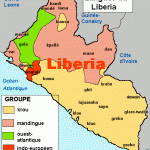
liberia-map-lng By Tewroh-Wehtoe Sungbeh


Vadro Kone’ is a friend, an Ivorian, who’s never shy to discuss his days in Liberia with me.

I thought I knew Liberia since it is my birth country, but when Kone’ opened his mouth to discuss his former adopted homeland, what he said reinforced my own sense of patriotism.

Like most people in search of good times and greener financial pastures, Kone’ left Cote d’Ivoire in the late ’70s to find work, spending five years in Liberia before that country fell violently.

Here’s the part of the story that is not so surprising.

Kone’ told me that his 5-year stay in Liberia were the better days of his life. “How can it be?” I asked. Because during the time he moved to Liberia, Cote d’Ivoire was the place to be because it was seen as developed and prosperous. Thanks to the heavy-handedness of the development-minded Felix Houphoet Boigny, the only President the people of that country ever knew long before its present-day problem.

“Liberians are nice and friendly, but are pompous,” Kone’ said. “While I was in Liberia, I worked hard and made U.S. dollars, learned English, joined the nite club scene and met few lovely Liberian ladies,” he also said.

Kone’ said again: “When I was in Liberia, I also heard Liberians say things like, I was born here, and I will die here. This is my country, I will not go nowhere. Now Liberians are all over the world.”

Vadro Kone’ is right about one thing. Before the civil war, Liberians always believed their country was the best thing that ever happened to them since the introduction of rice, the country’s staple to the population.

As I reflected on Kone’s comments, I also reflected on my dear Liberia, because as the Christians would say, “Liberia needs prayers for what she has gone through over the years.”

That’s because after the presidential election of 2005, many believed those dark days of corruption, poverty, neglect and inequality that partly agitated the civil war were behind them. Sadly, the nation has since returned to business as usual.

The late Liberian singer, Morris Dorley, said it well in his famous song that “no matter where you live, Liberia’s my home.”

That’s exactly what that country is to all of us, home. Infact some of our relatives, friends and loved ones are still living there. Though some perished senselessly during the 14-year civil war, others fled by sea, land and air to countries all over the world for safety, security and opportunities.

Though broken and destroyed, Liberia, I swear, will never be forgotten or be the same.

Just ask my friend, Vadro Kone’ and others including the Fulanis, Indians, Lebanese, Syrians, Africans, etc, etc, who made Liberia their home over the years. As Liberians hurrily got out of their country in droves because of economic and political reasons, non-Liberians are still moving in.

I miss Liberia, yah!

Who can dare forget those historical football rivalries between Mighty Barrolle and Invincible Eleven (IE)? Or a do-or-die football match between, let say, St. Joseph’s Warriors and Mighty Barrolle, IE or BAME?

In Liberia, we have our own handshake. Do you all remember that unique handshake? It is the handshake with the snapping of the fingers. A unique one that is as old as Liberia. And our own way of speaking the English language, completely different from most countries in the region. What’s about the historic ‘LU’ (University of Liberia) and Cuttington College. Two excellent institutions with great teaching traditions.

What can we say about Liberia without ever mentioning the historic Broad Street and Waterside? This article will be incomplete without mentioning historic neighborhoods such as West Point, Clara Town, New Kru Town, Logan Town, Gurley Street and Old Road Sinkor?

What about that old Liberian past-time, Club Beer? A cold Club Beer on a hot Liberian day can be reassuring. Or a not-so-cold cup of Palm Wine under Bong Mine Bridge, opposite PUA or LEC on Bushrod Island. Drinking Palm Wine out of those unsanitary cups with flies and bees flying around or dead in the pine wine was always an experience in itself.

In Liberia, we have streets and cities with Western (U.S.) names: Randall, Broad, Carey, Gurley, Benson, Newport, MacDonald, Mississippi, Maryland, Marshall, Lousiana, Lexington, Virginia, Arthington and many more, a clear reminder of our quasi-colonial past.

Our flag and Constitution? Well, look at the one in the United States and tell me whether you can tell the difference.

Anyway, why is it that policymakers never gave those streets and cities indigenous names reflective of the nation’s ethnic heritage? Or why our flag, our national symbol isn’t another color? Why is the Liberian flag copied after the American flag?

Perhaps an all black, red or orange flag with different colors springled around it, with a woman aptly named: Teahdee, TarNyonnoh, Musue, Bendu or Kamah as the proud designer, would have paid tribute to Liberian women. Instead, we have been told that the Liberian flag was designed by a “Susannah Lewis.” Again, that’s Liberia.

With its many problems and unlimited resources, Liberia can be a great country. Until it can be a great country, Liberia will always be home.