Subscribe via RSS Feed

Archive for April, 2014

Against the loneliess of innocents

By Clemente Ferrer Sudanese girl calling for help


” We share illusions” is the slogan of a notice published in newspapers of wide circulation. The aim of the campaign is to sponsor children in many countries who live in extreme poverty. This advertising campaign was promoted by the spanish NGO Intervida.

It is known to all governments that the Declaration of the Rights of the Child states that ” The child shall be protected against all forms of neglect, cruelty and exploitation.”

In a cruel world, such as the one we live, children are ” sad protagonists”: They are forced to subhuman work, malnutrition , sexual abuse and most suffer physical torture.

South Sudan is one of the 33 countries in crisis , as revealed by Unicef , and the worst of them all, according to the research entitled ” Humanitarian Action ” , which examines 21 African countries, eight Asian, two Hispanic and two European . The causes underlying the crisis in these countries are generic, according to Unicef.

Military conflicts are one of the primary causes of the crisis and the AIDS pandemic is the second : ” Not only for the high number of patients but also by the social consequences of HIV.” Finally the weather disasters: “Especially droughts cause poverty and exceptional vulnerability.”

The Horn of Africa (Somalia , Eritrea and Ethiopia) is the second most alarming area . The figures are frightening and 1.8 million kids are afflicted by the conflict in Southern Sudan , which together affects four million people.

Moreover, of the two million of displaced, the half are children. 60 % of deaths in children under five years are due to lack of food and this is the leading cause of death followed by respiratory contamination.

The situation is also serious in Afghanistan, where 165 newborns die per thousand surviving . One in four children dies before age five from easily curable diseases such as respiratory , measles or malaria.

The hard life of millions of kids, condemned to poverty, scragginess and lack of all because of a perverse distribution of goods among the poor countries are threats to the life of the most innocent and defenseless.


Author and journalist Clemente Ferrer has led a distinguished career in Spain in the fields of advertising and public relations. He is currently President of the European Institute of Marketing. [email protected]

Me, myself and I, and everybody for themselves

By Elder Siahyonkron Nyanseor Siahyonkron-Nyanseor1-130x150


Historian Carter Woodson, founder of “Negro History Week” once said: “When you control a man’s thinking, you do not have to worry about his actions. You do not have to tell him not to stand here or go yonder. He will find his place and will stay in it.”

Also, Dr. Philip Emeagwali wrote, “You do not need to send him to the back door. He will go without being told.” To which, Woodson concluded, “…If there is no back door, he will cut one for his special benefit. His education makes it necessary.”

Let me begin by first commenting on what Woodson and Emeagwali were referring, and then move on by sharing with you a discussion I listened to on the Liberia Destiny Debaters’ Forum on Monday, February 17, 2014. The forum was hosted by Mr. B-Slow Flomo. The guests were Mr. Moses D. Sandy, a Liberian journalist and Mr. Gabriel Nimley, the first Information Minister of the People’s Redemption Council (PRC) government. The topics discussed were: “Dishonesty as norm in President Sirleaf’s Liberia”, “Corruption/Kickback, Unconstitutional bills and more.”

Following Mr. Sandy’s brilliant analysis of corruption in the Sirleaf Unity Party government, a caller asked him this question: “Are you the same Moses Sandy who had a goldsmith shop in Monrovia?” Sandy said “yes.” The caller then said, “I used to visit your shop with two of my sisters to have their chains fixed; each time their chains became shorter by your employers.” I liked the way Mr. Sandy did not respond to the caller’s statement, since it had nothing to do with what he said about corruption in the Sirleaf government.

Some of us who advocate for good governance and transparency in government are sometimes told, “If you were there you would do the same thing. Even in the United States, there is corruption.” Statements like these are asked to evade the issues. Mr. Sandy went on to provide examples of corrupt practices in the Sirleaf government.

This brings me to the title of my article.

You see, these days in Liberia, “Me, myself and I, and everybody for themselves” have become the order of the day, and “Everybody for themselves, and God for all” has become the norm by which decisions are made. Very little has changed since I was a teenager in Liberia. In fact, it has gotten worse! The man in the street refers to this practice as the “same 6 & 7.”

Christians believe everybody should be for each other; but this is not the way of the world today. It has become “me, myself and I”; or “what is in it for me?” Since God’s help is for everyone, the practice of “Each one for himself and God for us all” should not be an acceptable way of life in any country! Why should this selfish practice continue when God has given us plenty to share? However, with the rate in which Liberia is being mortgaged to outside interests, sooner than later Liberia will be owned by others. This practice is done at the expense of the Liberian masses, reducing them to mere beggars; and making the country to lag behind most African nations in education, health services, safe drinking water, electricity, technology and infrastructural development badly needed to compete in the 21st Century’s global village.

This reminds me of Ed Schultz’s 2009 health care column in the Huffington Post titled: “My God, what has happened to America?” The focus Shultz wrote, “Senators Should Visit a Free health Care Clinic to Really See the America they Represent…and Deny”.

According to Shultz, what has happened to America is “GREED”. “… In our world there are takers, meaning the wealthy… Seems we have more takers than givers. GREED, GREED, GREED, GREED, GREED, GREED. THESE GREEDY PEOPLE ARE PREDITORS, SELFISH, MERCENARY, COVETOUS, AVARICIOUS AND COLD, COLD, COLD. I don’t believe they have a ‘clue’ as to what AMERICANS are going thru daily. They should trade places for a week and find out. BUT that would mean giving up their life of luxury.”

Ed Schultz went on to say, “I have just one question for those that have this insidious disease called “GREED”. HOW MUCH IS ENOUGH? Greed is wanting and taking all that one can get with no thought of other’s needs; desiring more than one needs or deserves. How many houses does one need, you can only be in one house at a time, in one room at a time. HOW many are out there with no homes as a result of Wall Street. Again GREED.”

Yet, with all what greed does to a people and country, we still have individuals who see it differently. One such individual was the caller on the Liberia Destiny Debaters’ Forum whose rationale for corruption in Liberia was “Liberian people’s lack of education. The host, Mr. Flomo responded that “Most of the corrupton committed in the Sirleaf government are committed by Book people.” This disproves the belief that with education, we will be able to reduce the practice of corruption. The fact of the matter is ordinary Liberians do not need to READ and WRITE in order to be able to identify corrupt practices in the country. Corruption is all around them!

It was the ordinary Liberians that referred to the late former Chairman Charles Gyude Bryant’s National Transitional Government of Liberia (NTGL) as: “Now it’s Time to Grab and Leave” or “Never Trust Government Leaders.” The same people referred to the People’s Redemption Council (PRC) government of Samuel K. Doe as “Plenty Rice Coming”; “People Ruled by Children” or “People Repeating Corruptions.” The Sirleaf government is not exempt. The people refer to her Unity Party (UP) government as “Unscrupulous Practices”.

In my view, nothing has really changed in Liberia. In fact, it has gotten worse! It is business as usual! The present leaders in Liberia lacked leadership qualities, i.e., vision, sound financial management; and more importantly, transparency. Bad governing practices have become the order of the day. As a result, most of the people in our country have gotten accustomed to corrupt practices. To them it is the way of life. The reason being, “since corruption cannot be eliminated, why hurt your head over it!” The common advice they offer is, “When the opportunity presents itself to you, take your share of the Elephant’s meat. Don’t complain when others are doing it; wait on your turn. Liberian government job is like a big Elephant meat; it is plenty. It belongs to anyone who can cut a bigger piece because if you steal from yourself (government), it is no sin at all.” And as the axiom says, “Steal from steal, (only) makes God laugh.”

As you shall see, corruption is not limited to politicians and government officials alone. It is within the family today in Africa. One Nollywood movie I watched makes the case for corruption, envy, and deceit in family relationship. The movie, “Proof of Life” (Parts 1 & 2) is about a man named Chike who is married with two kids, a boy, 6 years old, and the girl about 8 years old. Chike loved his extended family and would go to any length to help and satisfy their needs to the detriment of his own family.

This successful lawyer was exploited financially by his greedy relatives. They moved their own responsibilities to him believing that it is the tradition for him to fend for them since he is wealthy. The demands from them were too much for him to bear, and it soon affected his job, wife and kids. After things fell apart for him, he arranged his own death without the knowledge of his wife just to see how his family members (specifically his three brothers) would care for his family when he is dead.

Finally, he discovered through agony and astonishment that his extended family did not care about his wife and children. The money he left in trust for them to take care of his son, daughter and wife was converted for their personal use. Eventually, he revealed himself after he had tested each of his brothers. They failed the test by their uncaring actions to his family. This is a fact-based drama that must be watched by all Africans in the Diaspora!

Now, let me share with you a story about corruption in Liberia told to me by my mother. The story is about “John Johns’ Refusal to be Promoted.” According to the story: John Johns was a messenger (an expediter) in the Bureau of Customs at the Ministry of Finance. John Johns was troubled when he heard that his boss was considering him for a promotion. So he decided to bribe his boss to prevent him from promoting him.

Based on the bureau’s records, John Johns was the most dedicated employee in the history of the bureau. He was the only employee who worked seven days a week, the first to report to work, and the last to leave. These good qualities earned him consideration for a promotion. The promotion would be a salary increment of $75.00 per month. (This was in the 1950s).

However, the environment in which John Johns worked, “cold water” (bribery) was the practice. It was encouraged! If one refused bribe, he/she was considered ‘stupid’ or ‘naive.’ The promotion became a dilemma for John Johns. John Johns’ monthly starting salary was $25.00 when he was first employed; he had a wife and two children. Within five years, with five increments, he earned $50.00 per month. With this salary, John Johns supported his four children by his wife and two other children by each of his two girlfriends. With this meager salary, John Johns managed to build 4 concrete houses in less than a year.

Hearing the news that he was slated for promotion, John Johns grew weary and troubled. As a result, he quickly called on the personal friends of his boss to ask them to intervene so that his boss will change his mind regarding his promotion. He got his bosses’ friends to accept his proposition. Some of them even made remarks like, “If a person doesn’t want to be promoted, you can’t force that person.” Based on this rationale, the friends offered to help John Johns by agreeing to talk to their friend on his behalf. In exchange, John Johns promised to handsomely reward them. They decided to meet at the home of their friend, Mr. Johnson. John Johns made other arrangements with his boss’s wife. He provided funds for the entertainment. He gave Mrs. Johnson lots of cash to stage the event in grand style. In order for her husband not to leave home that day, Mrs. Johnson made sure to tell him that, “On Saturday some of your personal friends are coming over to visit; you need to be home to receive them.”

About 7:30 that evening, John Johns and the friends of Mr. Johnson showed up at his house. He was glad to see his close friends and associates. Mrs. Johnson served the guests expensive drinks and food. By then, Mr. Johnson began to wonder about the purpose for such an elaborate occasion. He was somewhat puzzled how his wife got the resources to provide such high-class entertainment. Looking at the reflection on Mr. Johnson’s face, John Johns got up quickly, took the center stage, and said: “Mrs. Johnson, Madam, thank you for your assistance in arranging this meeting.”

“Gentlemen, I thank all of you for responding to my request in a timely manner. However, before I begin to tell my boss the purpose for which we have gathered here, let me first thank God the Almighty for forgiving all of the bad, bad things I have done in my lifetime.” He then focused his attention on his boss. He said to him, “Chief, this palaver was called because I heard you were thinking about promoting me. Is there any truth to what they have been saying around the office?” The boss responded in the affirmative. “It is certainly true.” John Johns then said, “Chief, the reason I brought you this ‘cold water’ and ‘goat soup’ (bribe) along with your close friends and associates, is to beg you to not promote me. Chief, in the name of the Almighty God, please reconsider your plan. And if it means for me to give you half of my salary for your personal use, I would rather do so than to be promoted. Chief, I beg you; I love my present position very much! I do not want any increase nor to be promoted to another position. My present position was meant for me!”

As soon as John Johns got through speaking, Mr. Johnson thanked him for his concern and generosity and said to him, “If that’s what you want, I have no other choice but to adhere to your wishes.” He accepted the “goat soup”, “cold water” and the portion of John Johns’ salary without questioning him about his motives. After reaching this agreement, Mr. Johnson and his guests had a good time celebrating John Johns’ request not to be promoted.

In short, one must always strive to do what is RIGHT. Mr. Johnson failed this test! He accepted to do wrong for greed. His behavior reminds me of the statement the Catholic Archbishop Louis Ziegler delivered during the Fast and Prayer Day sermon. It reads:

“Now this (corruption) is on all levels, it comes from the family throughout to the top. If I had the time, I would demonstrate, a little bit where it is, because when we talk about corruption, we only think about those only up there, but deep down there, it is there and is being practiced every day. Now where is the training ground for this? It is within the family; let us work on that, our conscience, for the conscience of this nation seems to be dead, dead to sin and it needs to be reawakened.”

Arch Bishop Ziegler’s statement is a good example of what is required of us. Therefore, I say in this regard that if history is any guide to understanding the genesis of any country’s and direction and how it has been able to overcome major national concerns on such issues as corruption, ethnicity, reconciliation and national unity, the Liberian experience will leave much to be desired or appreciated.

The inherent problem of most African countries is the “lack of loyalty to the state.” For the most part, the loyalties of many Africans are geared towards their immediate or extended families, ethnic groups and personal friends. The state comes last! Americans and Europeans, on the other hand, tend to be loyal to their states.

Some political scientists tend to explain this inherent problem of African nations within the context of colonial domination—considering the fact that these nations were established by outsiders. Another explanation of the problem is found in Raymond F. Betts’s critical work: “In the Scramble for Africa: Causes and Dimensions of Empire.” Betts attributes Africans’ lack of loyalty to the state to the manner in which the Berlin Conference was established. Europeans carved-up Africa amongst themselves at these conferences (from 1884 to 1885).

Betts writes: The ‘Scramble’ suggests rapid and confused activity and, in this particular instance, a rush forward, a sort of treasure hunt. The metaphor therefore not only tends to describe vividly, it also tends to assign values to the historical action itself. The popular conclusion has long been that the opening up of Africa in the nineteenth century was done both with great haste and with reckless abandon as European explorers, missionaries, and military men brought European politics, culture, and confusion to a hitherto largely terra incognita.

This process generated different “spheres of influence” within various African nation-states that emerged out of the partition. Moreover, these newly established states were imposed on indigenous African populations. Africans did not participate in the formation of these states. In other words, these so-called nation-states were established by force and illegitimately. The same argument can be made regarding the so-called founding of Liberia.

In Liberia’s case, it was a group of white Americans in Washington, D.C. who took up “the White Man’s Burden” for The Grain Coast (the name Liberia was called prior to the arrival of the Settlers).

Due to the imposition of foreign hegemony, true nationalism or loyalty to the state never developed. The lack of loyalty to the state makes the African State fragile and the citizenry an easy prey for insincere ethnic politicians to exploit on the basis of sectionalism, tribalism, nepotism and personal relationship. As a result, African States have and continued to experience all sorts of social, economic and political problems. These problems are maintained, instead of being resolved. These corrupt leaders exploit the differences through the use of bribery, brute force, and other forms of corrupt practices, like what is going on in Liberia today.

The Liberian phenomenon is a sad commentary. It is hard to fathom how individuals who were nurtured, schooled and acquired the taste of American democracy - the citadel of world democracy would easily abandon these important virtues once they returned to Liberia and acquired power. Their corrupting influence has spread like wildfire destroying even the most basic structures for building a democracy.

There is truth to the adage - “Power corrupts, but absolute power corrupts absolutely.” This is clearly the case of the ‘Iron Lady’, Madam Ellen Johnson-Sirleaf, whom I once considered a friend for her expressed patriotism. Madame Sirleaf once referred to me as ‘Eminent’ before I became an Eminent Person of ULAA, and now it’s Chair.

How soon people forget history? The critic has assumed the practice she once condemned. She has now consolidated powers, and she is using it for the sole purpose of acquiring wealth at any cost, and pursuing its grandiose plans of maintaining power for herself, her children, relatives, friends, and her Unity Party government. And in the process, heightens repressive rule and tightens it stranglehold on the basic freedoms of the Liberian people.

Based on my research, selfishness and greed make corrupt individuals turn blind eye to the sufferings they inflict on others; and that corruption has become so rampant in some parts of the world, it has become an accepted practice. French lawyer Arnaud Montebourg laments that “Corruption is like a heavy pollution that weighs on people’s spirit.” The Economist also added, “As much as 10 percent of the $25 billion spent every year in international arms trade serves to bribe potential customers.” The magazine stated further that “corruption is but one form of oppression.” I agree wholeheartedly with this observation.

James Foley, a former U.S. deputy secretary of state puts it correctly when he said, “We all recognize that the cost of bribery is high. Bribes undermine good governance, harm economic efficiency and development, distorts trade, and penalizes citizens around the world.” Regarding this concern, on December 17, 1997, 34 major countries signed a “bribery convention” that is designed to “have a major impact on the global fight against corruption.” According to the convention, a crime is committed when one offers, promises or gives a bribe to a foreign public official in order to obtain or retain international business deals.

The practice known as corruption is as old as man. Some people argue that corruption started with the first family in the Garden of Eden, and that it exists in all human societies - from Genesis to Exodus. Yet, in almost all societies, there are laws against corrupt practices of any kind. If corruption goes unchecked, it will flourish and collapse continents. Unlike a tip that is given as an expression of appreciation for services rendered; bribe is a form of corruption that is given to prevent justice or for other dishonest purposes.

Dismayingly, however, apologists of the Ellen Johnson-Sirleaf Unity Party government lacks honesty, and is incapable of owning up to the mounting problems her administration has created either by its acts of omission or commission. They have shamelessly and deceptively engaged in a public relations war of words to deceive and make mockery of their real interests. Mouthing such phrase as “the Oldma is trying;” and calling for cessation of criticisms against her administration in order that we the so-called ‘Troublemakers’ will receive our share of the spoils of the people’s wealth. This deception has produced more deceptions, exposing its vulnerability and practice of corrupting the truth.

The fact of the matter is, since there is a total lack of honesty in the Johnson-Sirleaf administration, certainly it will be difficult for the government’s policies to escape the attention of any concerned and caring person. In retrospect, it astonishes me; yet, I am not too surprised by the behaviors of many Liberians regarding this cancerous practice of corruption.

John Gunther was wrong when he wrote over 50 years ago that, “Liberia is a sick country, one day it may get well”. Mr. Gunther’s diagnosis was WRONG! Liberia is not only a ‘sick country’, her illness has become terminal, and there seems to be no cure in sight.

As a matter of fact, because of the doctrine of “Me, myself and I, and everybody for themselves,” Liberia has become the only country on earth that disregard individuals who refused to steal the people’s money; instead, they considered them FOOLS and STUPID. Because those that steal, ride expensive cars, build big, big houses, have many girls/boyfriends, and send their children abroad to school. For these strange reasons, these individuals are admired and protected because some of these criminals and murderers are their relatives or they are from the same counties or are members of the same criminal network. This is the wrong way forward; therefore, these rogues and murderers need to be persecuted and not celebrated.

How soon we forget! How can we not see that there is something wrong with the corruption going on in Liberia? It is a historical fact that these rogues and murderers will not escape the fate that visited Tolbert, Doe, Taylor and many other corrupt African leaders. Nevertheless, I am in agreement with Charles Taylor who said, “The ant on the treetop will always find water to survive.” But if the ant is not careful, the water could kill it due to neglect and environmental contamination caused by the leaders who were supposed to take care of the environment.

As we may recall, it was corruption that hastened the downfall of the Roman Empire; so will it destroy those who engage in it - along with innocent people. Therefore, for anyone who called herself/himself President of a nation to use the people’s wealth to bribe others so as to continue corrupt practices, suggests that she/he is a criminal, as well and is morally bankrupt. Right this moment, corruption needs to be denounced in all of its forms and manifestations because what is sweet in Billy Goat’s mouth will eventually run its stomach. It is the same with corruption. Small amount of corruption, leads to the one that will destroy an entire nation.

Conclusion

The story of the ‘Greedy Workmen’ is a classic example of the Liberian people’s plight in the land of enormous wealth; yet, majority of its people cannot afford a cup of rice.

As the story goes, when Jesus came into the temple, the chief priests and the elders came to him as he was teaching, and said, “By what authority do you do these things, and who gave you this authority?

Jesus did not answer their questions, but he began to speak to them in parables, saying: “A certain man planted a vineyard and hedged it around about and dug a wine press in it and built a tower, and then let it out to workmen and went to a distant land.

“When the time of the harvest drew near, he sent his servants to the workmen to collect the fruits of the vineyard. But the workmen took his servants, and beat one, and killed another, and stoned another.

“Again he sent other servants, and they did likewise to them. Last of all he sent his son to them, saying, ‘They will respect my son.’

“But when the workmen saw the son, they said among themselves, ‘This is the heir. Come, let kill him and let us seize his inheritance.’

“And they caught him, and threw him out of the vineyard, and killed him.

“When the lord of the vineyard comes, what will he do to those workmen?” Jesus asked.

They said to him: “He will miserably destroy those wicked men, and will rent out his vineyard to other workmen, who will pay him his share of the fruit when they are ripened.”

When the chief priests and Pharisees had heard his parable, they knew that he spoke of them. But when they tried to lay their hands on him, they were afraid of the multitude because they took him for a prophet.

The story of the Greedy Workmen is similar to what is going on in Liberia; therefore, those of us who are advocating for good governance and transparency in government must continue to make our position clear as conscientious objectors; a position that the apostle Paul took against the corrupt Roman officials.

During the trial of Paul and Felix, the Roman governor delayed the trial, hoping that Paul would give him money to secure his release (Acts 24:22-26). Instead, Paul lectured him about “righteousness and self-control.” This is the same approach we must follow if we intend to discourage corrupt practices in Liberia, Africa and the world.

The statement by the late Archbishop Michael Francis is appropriate at this juncture. It reads:

We (Liberians) are in many instances insincere, dishonest, deceitful, and sycophantic. We have serious attitudinal problems. For the past two plus decades, our society has been so replete with a culture of violence, a culture of deception, a culture of dishonesty, non-achievement and multifaceted negative social attitudes that moral decadence has become the order of the day. There is now a looming fear that if this trend is not reversed our younger generation will grow up with negative attitudes, and this country will suffer greatly. Just think, sixty percent of our population was born after 1979 - one understands the magnitude of the problem.

We should address ourselves not only to healing the wounds of the past, but also to dressing the open wounds of the present. (From the speech the late Archbishop Michael Francis delivered on August 28, 2002 at the Government Reconciliation Conference in Virginia, Liberia).

Finally, we the advocates for “Rights and Rice” have come too far to betray our mission; therefore, my appeal to you is for us to rekindle our fighting spirit and passion like we did in the past; “We should not get tired or give up the fight. We owe it to the present and future generations of all species to rise up and walk!” (Wangari Muta Maathai).


Siahyonkron Nyanseor is Chair of the ULAA Council of Eminent Persons (UCEP), Inc. He is a poet, Griot, journalist, and a cultural and political activist. He is an ordained Minister of the Gospel. He is Chairman of the Liberian Democratic Future (LDF), publisher of theperspective.org online newsmagazine, and Senior Advisor to the Voice of Liberia newsmagazine. In 2012, he Co-authored Djogbachiachuwa: The Liberian Literature Anthology; his book of poems: TIPOSAH: Message from the Palava Hut will soon be on the market. Nyanseor can be reached at: [email protected].


Nanu Twaloh Sungbeh graduates Agnes Scott College, May 10, 2014.

Nanu Sungbeh's Agnes Scott College graduation 2014 Our daughter, Nanu Twaloh Sungbeh graduates Agnes Scott College with an undergraduate degree in Public Health. Join us at 9:00 pm at the Meeting Point, 2236 Hewatt Road, Snellville, Georgia 30039, to celebrate the occasion with us. Be there!

Nanu Twaloh Sungbeh graduates Agnes Scott College, May 10, 2014.

Nanu Sungbeh's Agnes Scott College graduation 2014 Our daughter, Nanu Twaloh Sungbeh graduates Agnes Scott College with an undergraduate degree in Public Health. Join us at 9:00 pm at the Meeting Point, 2236 Hewatt Road, Snellville, Georgia 30039, to celebrate the occasion with us. Be there!

PETITION TO REPEAL TITLE 4, CHAPTER 22 OF THE 1973 ALIEN AND NATIONALITY LAW OF THE Republic of Liberia

WE, the citizens of the Republic of Liberia, residing within the territorial confines
of the Republic of Liberia and in the Diaspora organized under the banner of
“The All Liberian Conference on Dual Citizenship” realizing that Liberia has experienced
social and political upheavals from the 1980 military intervention to 14 years of
civil war which forced hundreds of thousands of Liberians to flee their country
and become refugees, citizens or immigrants in foreign lands in Africa,
North America, South America, Europe, Asia and Australia; and

WHEREAS, there are approximately more than 500,000 Liberians residing outside the
Republic of Liberia in foreign lands; and
WHEREAS, the overwhelming majority of Liberians who re-settled abroad as a result of
intractable conflicts both the 1980 military and 14 years of civil war in the
Republic of Liberia creating new family by birth, changed their citizenship or
nationality as per Chapter IV Article 28 of the constitution but have also expressed
their commitment to maintaining their Liberian citizenship; and

WHEREAS, Chapter 22 of the 1973 Alien and Nationality Law of the Republic of
Liberia, as amended in 1974 , does not allow for Liberians to retain their
citizenship upon becoming citizens by birth, naturalization or other means of
foreign lands; and

WHERREAS, the turbulent social and political changes from 1980 to 2004 which forced
hundreds of thousands of Liberians to become citizens, refugees and immigrants in
foreign lands were not envisioned by the architects of the 1973 Alien and
Nationality Law and Constitution; and

WHEREAS, due to the 1973 Alien and Nationality Law, Liberians that naturalize abroad
are not only stripped of their Liberian citizenship but are also precluded from
owning land or other real estate in their native homeland as stated in Chapter III
Article 22 (a) of the 1986 constitution of Liberia; and

WHEREAS, the 1973 Alien and Nationality Law is in violation of Articles 11 (c), 20
(a) and 95 (a) of the National Constitution in that it discriminates on the basis of
gender, automatically imposes loss of citizenship without the institution of any
proceedings by the government which is contrary to the due process, and is
inconsistent with the 1986 National Constitution; and

WHEREAS, Chapter 22 of the 1973 Alien and Nationality Law, contravenes Article
27(a) of the 1986 Constitution of Liberia which states that “All persons who, on the
coming into force of this Constitution were lawfully citizens of Liberia shall
continue to be Liberian citizens”; and

WHEREAS, Chapter 22 of the 1973 Alien and Nationality Law is unjust and violates
fundamental rights, including the right to citizenship, as enshrined in various
international treaties to which Liberia is signatory;

WHEREAS, Section 20.1(b) of the 1973 Alien and Nationality Law unconstitutionally
discriminates against Liberian mothers in that it does not recognize children born
outside Liberia to Liberian mothers as Liberian citizens but recognizes children
born outside Liberia to Liberian fathers as Liberian citizens; and

WHEREAS, Section 21.30 of the 1973 Alien and Nationality Law further
unconstitutionally discriminates against Liberian women by providing a pathway to
citizenship for foreign spouses of Liberian men without providing a similar pathway
to citizenship for foreign spouses of Liberian women; and

WHEREASAS, restoring citizenship for Diaspora Liberians offers advantages of
broadening our country’s economic base, foster trade and investment, and provides
opportunities for Liberians in their host countries to influence economic and
development decisions in favor of Liberia; and

WHEREAS, the attainment of citizenship in foreign lands has enabled many Liberian
immigrants to secure employment and gain wealth, knowledge and thereby remit over 1
billion U.S. dollars to suffering family members during the civil war, and to
continue to transfer tens of millions of dollars each year back to Liberia to
support family members and stimulate the battered Liberian economy, share their
expertise in health, educational, business, sports institutions; and

WHERREAS allowing such Liberians to retain their Liberian citizenship will maximize
opportunities for Liberians living outside Liberia to obtain the necessary resources
(education, knowledge, skills and wealth) to help develop a working middle class for
Liberia that can serve as an engine for the reconstruction of the motherland;

NOW THEREFORE, we hereby call on the Liberian National Legislature to repeal the
1973 Alien and Nationality Law to allow for the retention of Liberian citizenship by
Liberians who naturalized in a foreign state, take an oath or make an affirmation of
allegiance to a foreign state, vote to elect the sovereign of a foreign state, enter
or serve in the armed forces of a foreign state or marry a citizen of a foreign
state or born in foreign lands to the union of a Liberian parent.

WE FURTHER CALL on the National Legislature to repeal without Chapter 22 of the 1973
Alien and Nationality Law regarding loss of citizenship for Liberians.
WE ALSO CALL on the Liberian National Legislature to repeal the 1973 Alien and
Nationality Law to provide for children born outside Liberia to Liberian mothers to
become citizens of Liberia, enjoying the same rights currently reserved for children
born outside Liberia to Liberian fathers, and to allow for children born to at least
one citizen parent to automatically retain his/her citizenship without taking an
oath of allegiance before or after attaining his/her majority;

A PROPOSED ACT TO REPEAL TITLE 4, CHAPTER 22 OF THE 1973 ALIEN AND NATIONALITY LAW
AS AMENDED IN 1974;

An Act to Repeal Title 4, Chapter 22, of the 1973 Alien and Nationality Law of The
Republic of Liberia as amended in 1974 and to Restore Liberian Citizenship
It is enacted by the Senate and House of Representative of the Republic of Liberia
in Legislature Assembled:
Chapter 1: Repeal of Chapter 22 of the Alien and Nationality
Law of 1973 (with amendments approved 1974)

Section 1.1 Chapter 22, of the 1973 Alien and Nationality Law, of the Liberian
Code of Laws Revised, is hereby repealed.

Chapter 2: Restoration of Citizenship
Section 2.1 From and after the effective date of this Act, a person who was a
citizen of Liberia whether by birth or naturalization, who lost his or her Liberian
citizenship under Chapter 22, of the 1973 Alien and nationality Law, of the Liberian
Code of Laws Revised is hereby restored to Liberian citizenship with all the rights,
immunities, duties and obligations of Liberian citizenship unless otherwise limited
or prohibited under this Act.

Section 2.2 A person whose citizenship is restored under this Act, who elects to
retain the Citizenship or nationality of another country shall not hold certain
public offices of the Republic of Liberia.

Section 2.3 No rights, immunities, duties and obligations of Liberian citizenships
restored under this Act shall be limited or prohibited unless specifically limited
or prohibited under this Act.

Chapter 3: Prohibition to hold Certain Public Offices of the Republic of Liberia
Section 3.1 A person who holds citizenship or nationality of another country in
addition to his/her citizenship of Liberia shall not be eligible to:
(a) hold the office of President or Vice President;
(b) be a member of the Senate or House of Representatives.

Section 3.2 A person who is prohibited from holding office(s) under Section 3.1 of
this Act shall automatically have his/her rights restored to hold said offices
immediately upon renunciation of other citizenship(s) or nationalities.
Chapter 4: Subjection to the Laws of the Republic
Section 4.1: A person whose citizenship is restored under this Act is subject to
all laws, including criminal laws of the Republic of Liberia, and to all treaties of
extradition or repatriation to which the Republic of Liberia is a signatory and to
all such other international laws and international conventions to which the
Republic of Liberia is an adherent party.
Section 4.2 A person who holds citizenship or nationality of another country in
addition to his/her citizenship of Liberia must use a Liberian passport to enter or
leave Liberia.

Section 5: Effective Date of Repeal and Restoration of Citizenship
Section 5:1 This act shall take effect immediately upon publication in handbills

Sincerely yours,
Signed:

ULAA Eminent Emmanuel S. Wettee
Chairman, The All Liberian Conference on Dual Citizenship

Approved:

Gaye D. Sleh,Jr
National President, ULAA
John Nimly Brownell

National P resident, EFLA

Francis William
National President, COLOSUS

John F. Lloyd
National Chairman CCL

Julia Mardea Richards

President ULAG

Bobby Whitfield
President , FOLICA

Contact Emmanuel S. Wettee at 614 683 8192 or
[email protected]

Alaric Tokpa visits metro Atlanta to discuss future of progressive movement, and upcoming senatorial race in Gbarpolu County

By Tewroh-Wehtoe Sungbeh Alaric Tokpa


During the week of April 11, longtime political activist and Gbarpolu County senatorial candidate Alaric Tokpa met with other activists in metro Atlanta to discuss his candidacy, and of course, to also discuss the direction and future of progressivism in today’s Liberia.

Dubbed “the week of the progressives” by host Issac Settro, who was kind and generous enough to lend his name, time, reputation and home to discuss a way to get the movement rejuvenated in order to get progressives elected.

Of course, the gathering was the kind needed to discuss and define the direction and future of the Liberian progressive movement, without being disrespectful of the ideas of others. And there were many good ideas thrown around that evening.

Speaker after speaker, however, touched on the discouraging and oft-times self-serving and embarrassing roles of Liberian progressives in politics, a ubiquitously opportunistic role which hasn’t gone well with a weary public searching desperately for a progressive leader who will finally deliver meaningfully for the nation and the Liberian people.

Alaric Tokpa, for his part, spoke gleefully and optimistically about the progressive movement’s chances of rebounding from the political doldrums that continues to set the movement back; and acknowledged that the movement will field a candidate in the 2017 presidential race.

Mr. Tokpa drew attention to the reorganization initiatives being undertaken by likeminded progressives to rejuvenate the movement for the future.

In an effort to remind the public not to count the progressive movement out, Tokpa added: “the progressives are now meeting on a regular basis. And whenever a meeting is called, it is standing room only; and the place is often overcrowded with people wanting to be a part of the discussion.”

“Discussions are still ongoing, and such a decision will be determined by the Liberian people as those with aspirations will be vetted when the time comes.”

On the future of the Liberian progressive movement, Tokpa said:

“The Liberian progressive movement is still relatively young, and has had a rather short-lived history when viewed within the context of the larger Liberian history.

Tokpa, however, acknowledged the failures of the Liberian progressives, adding, “One of the failures of the progressives was to not extract appropriate concessions from the ruling party in ushering in a new political dispensation.”

“Progressives working in the current government,” Tokpa added, “Are representing their individual interests. This has made it quite difficult to pursue policies that would bring about progressive change.”

Mr. Tokpa applauded the significant role of the Liberian Diaspora in contributing to the process of multiparty democracy in the country. Tokpa also applauded them for sending remittances back home.

“Remittances that Diaspora Liberians sent home have sustained livelihoods and the economy through the war years and now.”

Regarding out-of-country voting and Dual Citizenship, Tokpa added that he supports both efforts, because “Liberians as Liberians in the Diaspora are an integral part of their homeland, and should be included in the political process.”

When asked about his chances of winning the 2014 senate race, and why he lost the 2011 race for the House of Representatives? he said.

“My chances are very strong this time around. Unlike the 2011 elections, I entered the race rather late. I also got ill in the middle of the elections. This time around, I am engaged with my county.”

“I am currently working with the youths and the people of my county. I have donated building materials toward the construction of an elementary school, and I have contributed tools toward the construction of road (path) for motorcycles. I have also organized students at the University of Liberia to volunteer their time to teaching primary and secondary school children in the county, and I also developed plans to establish a library in the City of Gbarpolu.”

“Are you concerned that Robert Sirleaf, son of President Sirleaf is planning to run and challenge you in the race for the senate seat in Gbarpolu County,” a panelist asked?

“I am not concerned. His candidacy will not discourage me. I earned the respect and support of the citizens of my county,” Tokpa said.


ULAA puts all of its eggs in one basket

By Siahyonkron Nyanseor

ULAA's photo of the week

Last weekend was an interesting and rewarding one. I attended an inspiring event organized by a group of serious-minded and patriotic Liberians who gathered to discuss events in their troubled nation.

Isaac Settro, a young comrade hosted the meeting in Lawrenceville, Georgia on behalf of Prof. Alaric Tokpa, one of contemporary Liberia’s indefatigable revolutionaries. Prof. Tokpa had been touring the United States to share his vision with Diaspora Liberians. He is a forerunner for the Liberian senate seat in Gbarpolu County, in the mid-term elections slated for October 2014.

Following brief introductory remarks by comrade Settro, we individually introduced ourselves. Then rose Prof. Tokpa, the guest of honor telling us about his mission in the U.S while updating us about events in Liberia.

Tokpa challenged Liberians in the Diaspora to return to the days when their contributions made valuable impact on Liberia. He pointed out that Diaspora Liberians have masterminded both positive and negative changes in their country, including multi-party democracy and the devastating civil war. The somewhat violent struggle for democracy and the 14-year internecine war were the direct results of the intractable political, social and economic conditions that have existed in our country for nearly two centuries.

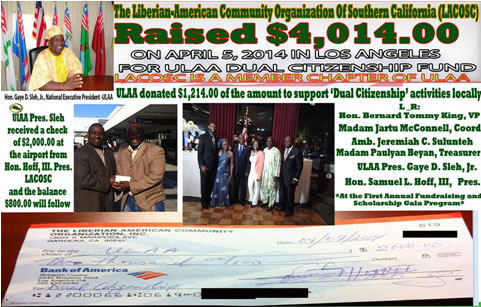
After listening to this perspicacious Liberian and having passionate exchanges with him, I woke up on Saturday morning only to find an e-mail captioned: “Photo of the Week.” The e-mail flaunted a figure of $4,014.00 raised in South California to support ULAA’s Dual Citizenship Fund.

My day got ruined! The current ULAA leadership has grossly failed to have its priorities together. It “puts all of its eggs in one basket.” The leadership is so obsessed with this Dual Citizenship thing that it is paying deaf ears to the current mismanagement of our nation’s resources by individuals who do not care for the ordinary people. Patriotic Liberians must give their undivided attention to the current state of our nation.

Last week, several articles appeared in FrontPageAfrica online magazine; The Perspective.org online magazine and The ANALYST magazine highlighting the stark disparities in society. These disparities have the propensity to derail the relative peace and stability in Liberia.

A compatriot Jucontee Tom Woewiyu recently spoke about this egregious injustice in an exclusive interview published in The Analyst, entitled: “Woewiyu Breaks Silence – Alarms at ‘Extravagant Salaries.’” “IMF Confirms Massive Liberia Budget Shortfall, Probe in $100M Road Works,” “Injustice at Justice: Poorly-Planned Plot to Oust Tah From EJS’ Gov’t” (FrontPageAfrica – Letter to Readers), and the article written by Isaac Vah Tukpah, Jr., “Liberia - How To Avert An Almost Inevitable Implosion (The Perspective.org magazine).

These articles are thought-provoking. They raised serious issues regarding injustice in President Johnson-Sirleaf’s Liberia. Yet, in the midst of all of these serious economic, social and political crises at home, ULAA and its officials are celebrating their “Dual Citizenship” Fund. The question I would like to ask is how can “Dual Citizenship” benefit Liberians in Liberia who barely live on $1.25 per day? Don’t get me wrong! I only want to know the immediate benefits of dual citizenship to the mass of our people at home who barely get enough to eat and send their children to school.

By the way, what is this Dual Citizenship? The last time I checked, Dual Citizenship is defined as being a citizen of two countries or more. That’s exactly what it means. For example, if a parent or parents who are U.S. citizens living and working in Germany, and they gave birth to a child there, that child is legally citizen of both the U.S. and Germany.

Not too long ago, the White House announced it wanted John M. Klink, who holds dual U.S. and Irish citizenship, to head the U.S. State Department’s Population, Refugees, and Migration Bureau. Find below what had to be considered in this case:

… As far as the United States is concerned, you are a citizen of the United States and have the same rights, privileges, and responsibilities as any other citizen, but that another country also recognizes you as a citizen of that nation. The U.S. State Department does not track the number of people who hold U.S. and other citizenships. As this State Department Web site points out, while the United States does not prevent dual citizenship, it does not encourage it either because of the potential for conflict in being subject to the laws of more than one nation. For dual citizens the country of residence is generally considered to have the greater claim on allegiance.

The most common routes to dual (or triple or more) citizenships are birth, marriage, or naturalization. For example, if you are born in the United States, you automatically become a citizen here. But if your parents are nationals-citizens-of Mexico, for example, you will also be a Mexican citizen. If your parents are each citizens of different countries neither of which is the United States, and you are born here, you could have triple citizenship at birth, depending on the laws of your parents’ countries. Conversely, if both your parents are Americans who are living abroad when you are born, you will again be considered an American citizen and possibly a citizen of the nation of birth, depending on what their rules are. The laws regarding dual citizenship by birth can get quite filigreed, depending on whether both parents are Americans, if they are married, and which parent is the foreign national.

Some nations confer citizenship if you marry a national of that country. For example, if an American marries a Greek, the American also gets a Greek citizenship. Marriage to an American by a foreign national does not convey citizenship here, just an expedited shot at it. People who become naturalized Americans-that is, they were born citizens of another country but through a legal process become Americans-do not have to give up citizenship of their previous country.

In some cases, they can’t because some nations do not allow people to give up their citizenship, even if they become naturalized citizens of the United States. But the United States expects such naturalized citizens to have primary allegiance to the United States. Dual citizens can, if they want to acknowledge the duality, be issued passports for each country of which they are citizens. But someone with a dual U.S. and other citizenship who gets in trouble abroad, particularly in the country the person holds the additional citizenship in, may not be able to get the same assistance from the U.S. embassy there as an American who has no additional citizenship.

Another potential source of trouble for a dual citizen is getting one’s American citizenship revoked. For example, serving as an officer in a foreign military, or having a high-ranking position in a foreign government has the potential to endanger U.S. citizenship. But the ruling principle is that by undertaking these actions one intends to give up American citizenship. It is also possible to voluntarily renounce U.S. citizenship, but simply wanting to stop being an American is not necessarily enough to make it happen. Ask Marc Rich, the fugitive financier who has multiple other citizenships but has not been able to get rid of his U.S one. To start the renunciation procedure, you have to be outside of the United States and swear your oath of renunciation to a U.S. consular officer. If the State Department in Washington grants the request, you are given a certificate of loss of nationality. That decision is irrevocable. That is, you can try to become a U.S. citizen again, but you have no special advantages toward that goal over other foreign nationals. http://www.slate.com/articles/news_and_politics/explainer/2001/05/what_does_it_mean_to_have_dual_citizenship.html

While out of a sudden Liberians in the Diaspora are preoccupied with this Dual Citizenship? Why?

In a recent edition of the New African magazine, I came across the statement that reads:

“Not having been back to Liberia since 2002, New African Editor Baffour Ankomah returned to Monrovia in early February to find a city under renewal. Progress is being made but a lot of challenges still remain, especially defeating corruption in high places and instilling accountability in public officials. Not surprisingly people are yearning for a stern hand in the steering of the ship of state, and the next elections in three years’ time will be a crucible for the candidates who will throw their hats into the ring.”

To which I say why wait for three years? When the fish gets rotten from the head, what do you do with it? You throw it out along with the water it is in. This is what needs to be done in Liberia, a country mismanaged by President Johnson-Sirleaf and her dis-Unity Party government that has become VERY famous throughout the world for CORRUPTION and UNACCOUNTABILITY.

Isaac Vah Tukpah, Jr. states correctly what we in the Diaspora MUST DO. In his recent article, “Liberia - How To Avert An Almost Inevitable Implosion,” published in The Perspective.org reads:

We can utilize our voices via the diaspora radios/internet services and via the social networks – Facebook and Twitter especially. We can stand our ground for our brothers and sisters in Liberia who are not at liberty to speak truth to power without being rounded up and arrested on charges of treason or terroristic threats. We can put up joint statements – LIBERIAN DIASPORA COUMMUNITY IN ONE ACCORD – USA, EU, Asia, Australia, and other African countries! Let’s use the freedom we have in this global village to bring the necessary attention to our plight at home before Madam Sirleaf’s playbook is fully executed and grows wings beyond our reach. Let’s defeat this mammoth monstrosity in its still developing stages and sear off forever the fist of Machiavelli and its enablers!!!! Who wants to stand by my side as we take this bold step to reclaim our country?

Whao! The brother couldn’t have stated it any better! Count me in; I am with you all the way because ULAA and its officials have failed us miserably. Recently, a well-placed source in Liberia told me that ULAA gets it marching orders from the Liberian government and the Liberian Embassy in Washington, DC. And based on my observation, it appears to be the case.

In “A Covenant Betrayed: Partisanship within ULAA and its Chapters,” I wrote in 2012 and 2013 that ULAA is “A Toothless Bulldog.” ULAA has placed all of its eggs in the basket of advocating for ONLY “Dual Citizenship” when most our people in Liberia go to bed hungry every night while a select few are paid, US$15,000.00, US$20,000.00 and US$30,000.00 a month. What a travesty of misappropriation of the Liberian people’s money and resources! Adding insult to injury, the Legislature wants Liberians seeking elected office to pay a registration fee of US$7,500.00 (pending approval by the Senate and the President).

Under Chapter 12 (Amendments) Articles 91 & 92 of the Constitution of Liberia, the Referendum of August 23rd, 2011 was in blatant violation of the Liberian Constitution. The requirements of the constitution explicitly states:

• the proposals should be published in the National Gazette and circulated throughout the Republic of Liberia via its information service;

• the referendum must be held not sooner than one year after the action of the Legislature;

The Liberian Constitution through its by-law dictates an “ORDERLY PROCESS” in the way and manner a referendum “MUST” be held, “How sequences started from beginning to end must be handle”.

However, the process leading to the August 23rd 2011 referendum sponsored by the Ellen Administration, and shoved down the Liberian people’s throats unequivocally contradicted the process as laid down by the Liberian Constitution. What was done was in violation of the constitution, and was not done legally. But then this is Liberia! Ellen gets whatever she wants!

CONCLUSION

In Ellen’s World

In the President’s memoirs, “This Child will be Great,” our first lady president of Africa who came to power promising to fix those things that were broken during both the Doe and Taylor administrations, wrote:

He [Doe] speaks of love for a people, but a people who are feeling the brunt of a steady economic decline which has left them impoverished. Unemployment, spiraling cost of living, the lack of medical facilities, inadequately equipped schools, little means of transportation and a depleted national capital stock are common conditions which they face. Even their culture and traditional ways of life are being threatened by wanton environmental degradation.

What a difference six plus years can make? Doe might be turning in his grave, and Taylor in prison saying, “I warned everybody, but no one wanted to listen to me. You didn’t know what I knew about Ellen, now you are seeing and experiencing it for yourselves; it was always only about herself, her son Robert, and her close friends and allies. I told you, you think I’m bad, but Ellen is worse!”

Fellow Liberians, those of us who know the history of this period very well can speak and write based on our experiences. Where Taylor failed in the 90s to have ULAA revive its failed ‘propaganda war’ in North America, Johnson-Sirleaf has succeeded with ‘flying colors.’

Swenju Juah, author of “ULAA Board at Loggerheads,” quoted in its September 15, 2001 publication from the New York-based Palava Hut magazine reads: “The board [ULAA] comprises elements on GOL’s payroll. By making public speeches against the ills of the Taylor regime, Mydea Reeves-Karpeh poses a serious threat to lifestyles of those who receive money from Monrovia.”

Is this happening today? Based on ULAA’s inaction regarding the Unity Party government’s treatment of our people at home, one could easily reach the conclusion that many of these leaders are on government’s payroll.

In short, it is safe to say President Ellen Johnson-Sirleaf has become the PRINCESS of ‘Machiavellian Politics’. She uses the Machiavelli approach cleverly, which is the “end justifies the means.” In Ellen’s world, one should do “whatever it takes” to achieve their goals no matter who gets hurt or killed.


Siahyonkron Nyanseor is the Chair of the ULAA Council of Eminent Persons (UCEP), Inc. He is a poet, Griot, journalist, and a cultural and political activist. He is an ordained Minister of the Gospel. He is Chairman of the Liberian Democratic Future (LDF), publisher of theperspective.org online newsmagazine and Senior Advisor to the Voice of Liberia newsmagazine. In 2012, he Co-authored Djogbachiachuwa: The Liberian Literature Anthology; his book of poems: TIPOSAH: Message from the Palava Hut will soon be on the market. Nyanseor can be reached at: [email protected].

Fomba Sirleaf’s timidity offers historical insight into presidential family’s interference and manipulation of political system

By Tewroh-Wehtoe Sungbeh Fomba Sirleaf


President Sirleaf’s Monrovia City Court jails radio personality Henry Costa for engaging in a heated on-air verbal feud with her son Fomba Sirleaf, who is also the president’s National Security Director.

A writ was later issued by Mr. Sirleaf to have Costa arrested. Talking about kangaroo justice in a government that prides itself of respecting human rights and individual liberties? A far cry!

No, the bad blood between the two men is not about a woman.

The popular radio personality was served a writ and arrested after he criticized the ruling political family about nepotism and corruption, and everything terrible Fomba’s mother has done wrong since she became President of Liberia.

Henry Costa was charged with terrorism. Can you believe it?

Do you think democracy and freedom of speech is alive and healthy in Ellen’s Liberia? I don’t think so.

However, the writ reads:

“That on the 26th day of February A.D. 2014 in the city of Monrovia, Montserrado County, Republic of Liberia, the within named defendant being there and then with malice and wicked intent, purposely did threaten the life of the said private prosecutor using against him death threats to harm and kill him, and that in the same vain the said defendant on the Costa Show on Radio Hot FM did make statement challenging the National Security Agency (NSA) Head, Fomba Sirleaf, who is the private prosecutor to engage him in a public fight wherein the defendant threaten to fight and public ridicule.” The alleged act of the defendant being unlawful, wicked and intentional is in violation of the sections 11.16 of the New Act amending section 14.24 of the New Penal Law, 14.25 and 14.27 of the New Penal Law of Liberia there and then crimes herein the defendant did do and commit.”

Within that same time period, the president’s 17-year old grandnephew Estrada Bernard III, who lives in Alaska and is still in high school, was invited by the National Oil Company of Liberia (NOCAL) to make a presentation (perhaps as an oil expert) on oil issues.

Madame Sirleaf, as usual, dismissed the public uproar over her grandnephew’s invitation to make a presentation on oil issues as “much ado about nothing.”

“You know something; it is a pity that one would make a 17-year old bigger than life, because he doesn’t deserve that kind of attention, quite frankly.”

“Let me tell you, you know, a group from – first of all his father is a neurosurgeon, who has been rendering free services here over the past 7-years. He comes here, he operates,” Sirleaf reportedly said.

Do we get no respect because the president’s grandnephew is the son of a neurosurgeon who operates freely in Liberia? Why not get an expert in the field to make a presentation that will be beneficial to all and those aspiring to be in the oil industry?

Now the Ebola pandemic, a public health crisis has once again exposed the Sirleaf administration of incompetence and lacked of leadership.

Unpreparedness in disaster management, lack of funding, lack of training, lack of staffing and lack of coordination, has hampered the nation’s readiness to deal with this particular disaster, and future disasters in the Republic of Liberia.

As the Ebola outbreak overwhelmed the nation, President Sirieaf, the (traveler in chief) she is unsurprisingly left the country to attend the 4th EU-Africa Summit in Brussels. Where’s her foreign minister? You would think the president would designate her foreign minister to attend the summit so that she can remain in the country to deal with the national emergency at hand. But no, and as usual, Ellen left the country at that crucial time for her usual travelfest.

A member of the House of Representatives or Senate should have taken the time to ask tough questions and seek genuine answers.

To his credit, however, only the president’s ally, Benoni Urey, a rich private citizen who’s reportedly contemplating running for president in 2017, criticized Madame Sirleaf about her leaving the country in the wake of the Ebola outbreak.

These are some the violations Liberians have to live with constantly in a country where the nation’s president, her family, her cronies and elected officials are not accountable to the people.

That is because Liberia’s political system is set up in a corrupt, selfish, monopolized and centralized way that gives more power to the president and elected officials, and zero or token power to the people.

Had Liberia been a genuine democracy with accountability and transparency constantly highlighted as the central themes of governance in the Sirleaf administration, tough questions would have been asked, and heads would roll for these violations.

So far, from what I have seen, there is no legislative oversight in the Republic of Liberia; and the president, her family, friends and cronies and appointed and elected officials can do whatever they want to do – violate the laws of the land without ever being held accountable for their actions.

However, I am sure Madame Sirleaf will claim not to have any knowledge as usual about the two events that occurred on her watch that (1) sent a Liberian to jail because he got into an on-air verbal dispute with her grown son (2) for inviting an unqualified ‘expert,’ a family member and a minor for that matter to lecture qualified grownups on energy issues.

Seriously, Liberian democracy needs a reality check.

Also, Liberians in general needs to reevaluate where we (they) stand in the intellectual, cultural and political defense of our country.

Our values, our self-esteems and everything we stand for including our pride have been attacked by this administration and previous administrations, as if we are non-humans. Even some non-humans – like the four-legged animals have been treated far better than the way we have been treated by our government.

For too long, we as a people have stood by supinely and witnessed in fear to the detriment of our country and families the lies, the disrespect, the political neglect, poverty and the flagrant abuse of power, which helped to take some of our loved ones away from us way too soon.

So, is it right and normal for a lady who supposed to be president of all Liberians to protect her grown son, a grown man from another man because of an on-air feud, which both gentlemen could have solved with a handshake?

I can certainly understand those parental feelings and instinct of trying to protect one’s offspring from a would-be predator.

In this case, however, Henry Costa is not a predator; and Fomba Sirleaf is a public official – a grown man who is capable of defending himself in a polarized political climate such as Liberia where he, as (National Security Director) does not need mommy and her court system to defend and protect him.

What this one-sided presidential-judicial intervention did once again is make a darn mockery of the judicial system.

It also put Liberians on notice to leave President Sirleaf’s children and family alone, else, those Liberians will be sued and be served a writ of arrest, as the president has done several times in the past when she sued Liberians who challenged her and her corrupt administration.

With President Sirleaf’s $200 million paid foreign public relations people watching and working to make her look good abroad, she will soon receive another foreign award, even though her leadership at home is less than stellar.


Supt. J. Milton Teahjay’s upbeat about Senatorial race, and hosting 2014 Independence Day celebration in Sinoe County

- Staff J. Milton Teahjay

Amid a tough and looming senatorial race, Sinoe County Superintendent J. Milton Teahjay is in high spirit as he prepares for a bruising senatorial campaign, and his county hosting of the annual national Independence Day celebration scheduled for July 26.

Speaking to our reporter this morning in Monrovia, Mr. Teahjay said he is elated to have received his county’s share of $650,000 from the Liberian government for the celebration, and will use the money for its intended purpose.

“We have contractors to pay. We have other employees to pay. We have to construct few more buildings and arenas. We have to entertain our guests and citizens. We have to decorate and have a clean and safe city. And we also have to upkeep the park and the other infrastructure in Greenville for the celebration, Teahjay said.

“Another thing, I got rid of the corrupt advance payment system, which was used by unscrupulous officials to milk the county out of funds. I instituted a system that pays the contractors immediately after the job is inspected, completed and turned over to us by the contractors,” Superintendent Teahjay said.

“Contrary to reports by Front Page Africa that I entered into a million-dollar contract for the electrification of Greenville City without the Public Procurement Concession Commission (PPCC’s) regulations, I want to make it clear that I never embezzled a penny from those funds.”

“That kind of sensationalism in journalism is the kind that got Rodney Sieh in trouble the last time. He did not check his facts, and Front Page Africa just ran with the story to get readers.”

“Now tell me. How can a man, a Superintendent who is believed to have committed a crime by circumventing the contracting process to benefit his pockets be entrusted with $650,000 to fund the July 26 national celebration for his county?”

According to Superintendent Teahjay, the July 26 national Independence Day celebration in his county will go on as planned, and it will be memorable and one of the most successful celebrations of our nation’s independence in our county’s history.”

Superintendent Teahjay dismissed his public battle with Sinoe County Representative Matthew Zarzar as a ‘non-issue,” and called on his fellow Sinoean to work with him to make the upcoming July 26 celebration in their county a successful one.

“A feud with Rep. Zarzar will not help our suffering people. It will not send their kids to school. It will not feed them either. So, I am calling on Mr. Zarzar and others to put away their differences with me so that we can make Sinoe County a better place to live, to raise a family and do business,” Mr. Teahjay added.

With a tough senatorial race between him and incumbent Mobutu Nyenpan around the corner, the question is how can he beat an entrenched status quo senator like Nyenpan? Mr. Teahjay admits, “It will be a tough race, but I am going to win.”

“I am going to be the next senator of Sinoe County because Senator Nyenpan’s heart is not in Sinoe County but in Monrovia. He is a Monrovia senator,” Teahjay said with confidence.


Moses Owen Browne, Jr appointed Global Youth Ambassador for Education

- Staff Moses Owen Browne


Journalist Moses Owen Browne, Jr has been appointed Global Youth Ambassador for Education. Mr. Browne was among 500 young advocates selected around the world to champion the cause of ‘Global Education for All.’

Mr. Browne who officially accepted the position April 1. called attention to the 57 million children around the world who are currently being denied their human rights to education.

“I am joined in this call to action by 500 other young advocates for global education. Together, we make up the Global Youth Ambassadors group – launched on April 1, 2014, by the United Nations Secretary-General Bank Ki Moon and the United Nations Special Envoy for Global Education Gordon Brown.

“Though I acknowledged the strides Liberia’s education sector is making particularly, in the areas of policy formulation and construction of classrooms, let me also encourage our government to particularly improve the learning conditions of pupils and increase enrollment,” Browne remarked.

Journalist Browne stressed that the country’s education sector is gradually improving but enrollment, retention and education infrastructure development, as well as funding for the sector are major factors leading to the decline in the sector.

“It is no secret that more than 70 percent of our schools were destroyed during the country’s bloody civil war, and most school-going children were denied the opportunity of acquiring basic education and enrollment. Many of our teachers were killed and others fled to exile for fear of being killed in the war. Today, the war is over, and Liberia has enjoyed 10 years of sustained peace. I am saddened to see many young children in the streets today selling cold water, grand peas and boil eggs when they suppose to be in schools learning like other children around the world,” Browne lamented.

In August 2013, I travelled to a small place called Zedyou Town, 10km away from Buchanan City, Grand Bassa County. Tears filled my eyes when I met a little Angel Browne, unreleated, and not her real name, who was 15 years old at the time. She narrated that she lived with her parents, and has never been to school. Though she’s eagered to go to school, the Sande Society won’t permit her. Her parents have trapped her to join.

Little Angel’s parents also forced her to marry a 40 year-old man, a vegetable farmer in the same village. Her mom told me she must go through their tradition before anything else, even school is not a priority until she’s fully initiated in the Sande bush and get marry. I was grief-stricken. I couldn’t believe my eyes. I am sure this is happening in other villages around Liberia.

Little Angel’s story, and that of so many other young people in Liberia and other parts of Africa and the world at large inspires me to stand up for the millions of children that are kept out of school because of poverty, early marriage, child labor, and different forms of discrimination as well as lack of governance structure, little funding to the sector and lip service from those in authority.

As a firm believer that education is the answer to the greatest challenges we face as a society, I am appealing for every Liberian support; and support from parents, government and civil society and philanthropists to help in urging our leaders to raise budgets, build schools, train teachers and improve learning for all children.

It has been shown that we could lift over 170 million people out of poverty simply by teaching every child in low-income countries like Liberia basic reading skills.

So why are we not making this a reality?

Unless we revert current trends, we will not even achieve universal primary education before 2086. So Join A World at School campaign to get every child into school learning. Support our calls to action and get all the latest news on global education online (www.aworldatschool.org) on twitter (@aworldatschool) and on Facebook(www.facebook.com/AWorldAtSchool).

Moses Owen Browne, Jr. can be contacted on Cell #:+231-886-493-370 and emails: [email protected],[email protected], Face book https://www.facebook.com/browne.moses.