Subscribe via RSS Feed

Archive for December, 2012

"I can say to you very clearly, you will not see my name on any ballot paper any time soon,” says Leymah Gbowee

By Staff Writer Nobel Laureate Leymah Gbowee


Liberian Nobel Laureate, Leymah Roberta Gbowee, has said that she has no immediate desire to run for any political office in her land of nativity-Liberia. In a Christmas Eve Voice of America (VOA) interview, the 2011 joint Nobel Peace Prize winner indicated that although she loves politics, she has no immediate desire to run for political office in Liberia.

Madam Gbowee, in 2011 emerged joint Nobel Peace Prize winner with fellow Liberian, President Ellen Johnson-Sirleaf and Yemeni Peace activist, Tawakkul Karman, for what the Norwegian Nobel Committee called an honor “for their nonviolent struggle for the safety of women and for women’s rights to full participation in peace-building work.”

Said Laureate Gbowee: “Let me say one thing, my life has always been one of giving back. I tell people I’m a Liberian and I have the right to decide if I want to go into politics.” However, the Nobel Laureate, who is also a social worker, was quick to register that: “But one of the things that I can say to you, very clearly, you will not see my name on any ballot paper any time soon.”

Madam Gbowee’s assertions come on the heels of recent criticisms from critics of the Nobel Laureate, who have accused her of being ambitious of state power.

Recently, several critics of Madam Gbowee, mostly females, lambasted the Nobel Laureate for what they called her [LeymahGbowee] unfair utterances against President Johnson-Sirleaf, adding among other things that Madam Gbowee was criticizing the Liberian leader to gain prominence for a possible run for political office.

While in Paris, France more than two months ago promoting the French edition of her book, “Mighty Be Our Powers”, Nobel Laureate Gbowee resigned as chair of the nation’s peace and reconciliation initiative; on grounds that the Johnson-Sirleaf led government has made no sufficient progress in promoting reconciliation, also blaming the Johnson-Sirleaf administration of not only condoning corruption but also of practicing nepotism.

Madam Gbowee , who stated that she stands guilty of betraying the people’s trust by working in a government that is guilty of closing its eyes to corruption in high places, views her resignation as an act of forgiveness from a raging conspiracy that President Sirleaf has awarded “lucrative jobs” to her sons in a blatant act of nepotism.

She lamented that the president’s appointment of one of her sons, Charles, as central bank deputy governor, another (Fumba) as head of the National Security Agency, and the third (Robert) as senior adviser and chairman of the state-owned National Oil Company of Liberia (NOCAL) was unacceptable.

Regarding President Johnson-Sirleaf’s son Robert Sirleaf, Nobel Laureate Gbowee averred: “This is wrong and I think it is time for her to put him aside.” “He’s a senior economic adviser and that’s well and good - but to chair the oil company board - I think it’s time he stepped aside.”

Said Laureate Gbowee: “I’ve been through a process of really thinking and reflecting and saying to myself ‘you’re as bad as being an accomplice for things that are happening in the country if you don’t speak up.” “And when tomorrow history is judging us all let it be known that we spoke up and we didn’t just sit down.”

She acknowledged that the Johnson-Sirleaf led government has done a good job in rehabilitating the country’s infrastructure, but was quick in pointing out that the rehabilitation of the country’s infrastructure was not good enough for a country in which poverty was fast determining the social status of most Liberians.

Listen to Madam Gbowee: “What good is infrastructure if people don’t have enough to eat?” “In her [President Johnson-Sirleaf] first term she developed infrastructure. But what good is infrastructure if people don’t have enough to eat? Development in a land of hungry, angry people is nothing. The gap between the rich and poor is growing. You are either rich or dirt poor, there’s no middle class.”

- Heritage

“I can say to you very clearly, you will not see my name on any ballot paper any time soon,” says Leymah Gbowee

By Staff Writer Nobel Laureate Leymah Gbowee


Liberian Nobel Laureate, Leymah Roberta Gbowee, has said that she has no immediate desire to run for any political office in her land of nativity-Liberia. In a Christmas Eve Voice of America (VOA) interview, the 2011 joint Nobel Peace Prize winner indicated that although she loves politics, she has no immediate desire to run for political office in Liberia.

Madam Gbowee, in 2011 emerged joint Nobel Peace Prize winner with fellow Liberian, President Ellen Johnson-Sirleaf and Yemeni Peace activist, Tawakkul Karman, for what the Norwegian Nobel Committee called an honor “for their nonviolent struggle for the safety of women and for women’s rights to full participation in peace-building work.”

Said Laureate Gbowee: “Let me say one thing, my life has always been one of giving back. I tell people I’m a Liberian and I have the right to decide if I want to go into politics.” However, the Nobel Laureate, who is also a social worker, was quick to register that: “But one of the things that I can say to you, very clearly, you will not see my name on any ballot paper any time soon.”

Madam Gbowee’s assertions come on the heels of recent criticisms from critics of the Nobel Laureate, who have accused her of being ambitious of state power.

Recently, several critics of Madam Gbowee, mostly females, lambasted the Nobel Laureate for what they called her [LeymahGbowee] unfair utterances against President Johnson-Sirleaf, adding among other things that Madam Gbowee was criticizing the Liberian leader to gain prominence for a possible run for political office.

While in Paris, France more than two months ago promoting the French edition of her book, “Mighty Be Our Powers”, Nobel Laureate Gbowee resigned as chair of the nation’s peace and reconciliation initiative; on grounds that the Johnson-Sirleaf led government has made no sufficient progress in promoting reconciliation, also blaming the Johnson-Sirleaf administration of not only condoning corruption but also of practicing nepotism.

Madam Gbowee , who stated that she stands guilty of betraying the people’s trust by working in a government that is guilty of closing its eyes to corruption in high places, views her resignation as an act of forgiveness from a raging conspiracy that President Sirleaf has awarded “lucrative jobs” to her sons in a blatant act of nepotism.

She lamented that the president’s appointment of one of her sons, Charles, as central bank deputy governor, another (Fumba) as head of the National Security Agency, and the third (Robert) as senior adviser and chairman of the state-owned National Oil Company of Liberia (NOCAL) was unacceptable.

Regarding President Johnson-Sirleaf’s son Robert Sirleaf, Nobel Laureate Gbowee averred: “This is wrong and I think it is time for her to put him aside.” “He’s a senior economic adviser and that’s well and good - but to chair the oil company board - I think it’s time he stepped aside.”

Said Laureate Gbowee: “I’ve been through a process of really thinking and reflecting and saying to myself ‘you’re as bad as being an accomplice for things that are happening in the country if you don’t speak up.” “And when tomorrow history is judging us all let it be known that we spoke up and we didn’t just sit down.”

She acknowledged that the Johnson-Sirleaf led government has done a good job in rehabilitating the country’s infrastructure, but was quick in pointing out that the rehabilitation of the country’s infrastructure was not good enough for a country in which poverty was fast determining the social status of most Liberians.

Listen to Madam Gbowee: “What good is infrastructure if people don’t have enough to eat?” “In her [President Johnson-Sirleaf] first term she developed infrastructure. But what good is infrastructure if people don’t have enough to eat? Development in a land of hungry, angry people is nothing. The gap between the rich and poor is growing. You are either rich or dirt poor, there’s no middle class.”

- Heritage

Koijee’s suspension confirms CDC’s problems, and George Weah’s lack of leadership

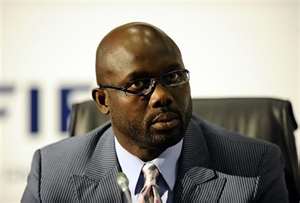
By Tewroh-Wehtoe Sungbeh George Manneh Weah


If I had a political party and ran for president once and lost, and I am thinking about running again in 2017, I most definitely will step up my game to succeed the next time.

To remain competitive, relevant and taken seriously, I will deliver policy papers quite often, and will frame compelling messages about jobs and education, healthcare, environment and security, and other issues that affects the Liberian nation and people.

I will also restructure my political party to be discipline, to focus on winning elections, and not be viewed as a party of intolerant thugs and political opportunists who are interested in serving a singular personality than the nation and the party.

I will try not to confuse or weave my roles as a political party leader and future presidential candidate with anything that questions my credibility and commitment to the Liberian people.

Because my political party is seen as the most popular in the country, I or we will not operate in name only. I will push my legislative members to legislate instead of being benchwarmers and cheerleaders for the administration and our political party.

Since my popularity stems from my exploits as a former football star, and since most Liberians don’t think I am a smart person who understands and knows how to articulate the issues, I will hire and bring onboard individuals whom I will listen to to guide me in these areas.

To be believable and credible as a would-be leader, I will project an image of confidence and competence; and cannot be seen as indecisive and embracing questionable alliances, and meandering all over the place without a clear message that inspires and resonates with the public.

Because politics is about ideas, vision and convincing others to follow, it is advisable not to live on past glories, but to be effective in the present.

George Manneh Oppong Weah, the former football star-turned politician whose Congress for Democratic Change (CDC) political party supposedly is the largest organization in the country, finds himself in that position.

The recent suspension of Youth Chairman, Jefferson Koijee by the CDC political party after he publicly criticized party leader, George Weah during the recent Vision 2030 conference in Gbarnga, for accepting the ceremonial “Peace Ambassador” position from President Ellen Johnson Sirleaf, speaks of the disarray and level of intolerance and political immaturity in that group.

Koijee’s suspension is ‘indefinite,’ a statement from the party reads.

The statement also reads: “The party informs the public of the immediate suspension of Mr. Koijee, pending investigation, consistent with Part II Bye Laws: chapter I, Codes of Conduct, Rule 14 of the Bye-Laws and constitution of the CDC.”

Since when is a person suspended without first being investigated and put on trial to prove guilt or innocence for the alleged crime he or she committed? Do you suspend a person indefinitely before investigating them to know what actually took place?

That undemocratic method of operation only exists in oppressive, personality-driven organizations like the CDC, and totalitarian regimes where the worshipping of the individual is paramount to the institution or country.

However, no matter how serious the nature of the crime is as party chair George Solo and the CDC alleged, a person cannot be denied his or her substantive rights such as freedom of speech and religion, because the individual publicly criticized the leader of a political party.

While it is evident that George Solo was shamelessly pandering to George Weah by flexing his muscles to please him, Weah so far hasn’t made any public comment that dissociates him from the mess that seems to put his credibility under the microscope.

So why is Weah, the opposition leader he supposed to be is risking everything - his credibility and his party’s credibility by accepting a ceremonial job from a president whose policies his party opposes on all fronts? Does Weah need the money and the fame, which he already has?

Did Sirleaf copied the playbook of her predecessors, Tubman, Tolbert, Doe and Taylor by offering Weah a ceremonial position to silence him, and weaken his party and his own chances off ever becoming President of Liberia after she departs the political scene?

Weah seems to have self-flagellate and fallen into the trap set by Ellen Johnson Sirleaf and her Unity Party, meant to keep him confused and side tracked. Sirleaf’s trap did not only cause leadership problem for the CDC, it cheapens Weah and undermines his credibility as an opposition leader.

As a political leader, Weah should have consulted with his party members after he was approached by Sirleaf to be her Peace Ambassador (whatever that is), because this is not about Weah, but about the people of Liberia and the future of his CDC political party.

The CDC boss’ undemocratic stance certainly is not a good sign for democracy in Liberia. As big as the CDC is on hyperbole and reckless adventurism, is that political party ready to lead if they are ever given the chance in 2017?

Can the CDC, in the wake of this and previous breaches uphold the little democracy the people of Liberia are now enjoying, especially when the party and its leaders actually failed over the years to be tolerant and democratic?

Nepotism rewritten with an Ink of pure Nobel Gold: A more appealing kind of nepotism?

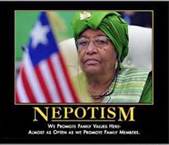
Johnson Sirleaf's NepotismBy Moco McCaulay Moco McCaulay


As the debate over nepotism rages in Liberia regarding President Ellen Johnson Sirleaf’s appointment of her three sons to key posts in the Liberian government, fermenting simmering disaffection with her leadership, not only has Africa’s first woman president’s commitment to reconciliation in her post-war nation come into question, but her recent utterances in praise of nepotism must certainly leave readers of her memoir, This Child Will Be Great, rather befuddled whether she is one and the same person who authored that book.

Granted, there is a book out there called In Praise of Nepotism: A Natural History by Adam Bellow, which from the look of things, President Sirleaf, a 2011 Nobel Peace Laureate, would now not only gushingly endorse, but with her unabashed display of nepotism in her war-addled nation despite her people’s outcry, she may probably also want to consider authoring a book extolling nepotism.

But until such a time, to have read President Sirleaf’s book and now hear her defend nepotism, one has to be flabbergasted at the disturbing contradictions in the voice of the author of “This Child Will Be Great” who, on the one hand, cast aspersions on past leaders for nepotism, now using her voice to staunchly defend nepotism on the other.

The Author’s Voice

Writing about the social urgency for change that was obtained in Liberia in 1971 after William Tolbert came to power and began instituting reforms to uplift the long marginalized indigenous population of Liberia, President Sirleaf said Tolbert had a “true development agenda” and that “given a different set of circumstances, he might have succeeded.”

That notwithstanding, in the next paragraph, she goes on to cast aspersions on President Tolbert as lacking the “courage and strength” to change the status quo.

“Any person stepping into the job of president in 1971 would have needed tremendous courage and strength to break the cycle of corruption, nepotism, and privilege that had so long held the country in a stranglehold, while at the same time navigating the waves of change coming his way. Liberian society was more unsettled than it had ever been. What had been a largely docile, uneducated population of young natives had now been radicalized, bringing to memory all the cleavage and disadvantages of the past and using that as a political tool. It was a highly combustible time,” President Sirleaf wrote in This Child Will Be Great (pg. 67).

In another passage in her book, President Sirleaf writes that after the Rice Riot on April 14, 1979 when ordinary Liberians took to the streets to protest the hike in the price of rice, which turned violent resulting in the deaths of several protestors, she was one of the members of a commission set up to investigate the incident and make recommendations.

In the commission’s final report, President Sirleaf said that it urged President Tolbert to “create a code of conduct for all public officials that would begin to tackle corruption and conflicts of interest so rife throughout government.

“Quite pointedly, the commission called on President Tolbert very specifically to examine the social impact of the very high visibility of so many of his relatives in monopolistic business venture,” President Sirleaf wrote, again raising the issue of nepotism in Tolbert’s administration as a bane to the process of national reconstruction that he was, in principle, trying to achieve.

But rather than adopting the commission’s recommendations, President Sirleaf said Tolbert ignored the report.

“What is tragic, I believe, is that had Tolbert instead implemented the major report recommendations of the Commission on National Reconstruction, things might well have turned out differently. Had the government seized the opportunity to make major changes, it could have turned the whole thing around and avoided all the bloodshed to come,” President Sirleaf so poignantly noted in This Child Will Be Great (pg. 90)

Apparently, by President Sirleaf’s reckoning, probably April 12th, 1980 and all the subsequent violent episodes in Liberia’s recent history could have been avoided had Tolbert displayed greater “…courage and strength to break the cycle of corruption, nepotism, and privilege that had so long held the country in a stranglehold…”

The President’s Voice

But it is much too easy for President Sirleaf, with the luxury of historical revisionism at her disposal, to slight Tolbert and other past Liberian leaders for failure to seize “…the opportunity to make major changes…”

Therefore, putting historical revisionism aside, the question then is:

Now that President Sirleaf stands in Tolbert’s position as the leader of a “Liberian society that is more unsettled than it had ever been,” (and after a brutal 14-year civil war, the current Liberian society is arguably even more unsettled than it was in 1971), has she displayed the “…courage and strength to break the cycle of corruption, nepotism, and privilege that [have] so long held the country in a stranglehold…?”

It would seem, not unlike Tolbert, and despite her “true development agenda,” President Sirleaf also has hardly shown the “courage and strength” needed to radically overturn the status quo which has held the country in a stranglehold.

Not only has President Sirleaf failed to prosecute officials accused of corruption despite her 2006 inaugural pronouncement to make corruption “public enemy number one,” she also seems to have adopted Tolbert’s playbook by placing her relatives in highly visible public positions and thereby, inflaming public concerns over conflict of interests without, for all intends and purposes, giving a hoot about the social impact on the Liberian society.

Take her recent interview with Radio Netherland Worldwide (RNW) for example, where President Sirleaf not only justified her crass show of nepotism in Liberia, but also dismissed public protestations.

RNW: You are a beloved leader around the globe and received the Nobel Peace Prize in 2011. Yet, in your own country you’ve been accused of nepotism and corruption. Three of your sons have been appointed to high government positions. How do you explain this?

Pres. Sirleaf: “We have a country that has a very low capacity. Some of our institutions – the ones that have to carry out the important reforms for the transformation of our country – simply do not have the capabilities. They also sometimes lack sufficient integrity to be able to do what is right.

“We have to place certain people close to us in positions to carry out our mandate of reform at the level of competence and honesty that is needed.

“Nepotism is putting somebody who is a relative in a position for which they don’t have the qualifications, integrity or competence. There are times when you have to hire relatives, even when it’s a temporary measure, to achieve your objectives.”

RNW: So you will not fire your sons? To show that you are a hero of anti-corruption?

Pres. Sirleaf: “No, I will not. There is a mandate and there’s a job to be done. When that job and mandate is done, perhaps they’ll move on to other things.”

President Sirleaf seems to be saying that because of personnel capacity and trust dearth, she is left with no choice but to place her relatives in certain positions to “carry out the important reforms for the transformation” of Liberia.

I can’t help but wonder when President Tolbert discounted the Commission of National Reconstruction’s report whether he too had a made similar calculation.

But President Sirleaf doesn’t seem generous enough to give Tolbert the benefit of the doubt. Instead, she is all too willing to besmirch his legacy by accusing him of lacking the “…courage and strength to break the cycle of corruption, nepotism, and privilege that had so long held the country in a stranglehold…”

Doesn’t the good Scripture say something about first casting out the beam out of our own eyes before trying to cast out the mote out of our brother’s eye?” (Matt. 7:5)

An Animal Farm Redux?

So unless President Sirleaf believes that her nepotism is somehow better than Tolbert’s, or to paraphrase Napoleon the pig in George Orwell’s Animal Farm, “all nepotism by leaders is nepotism, but nepotism by some leaders is better than others,” she may also want to strongly “examine the social impact of the very high visibility” of her sons in public positions, to borrow from the Commission of National Reconstruction’s report to Tolbert, which he ignored.

Liberians are much too keenly aware of the high price their nation has paid because far too many leaders have fallen short of the courage and strength needed to change the status quo. We therefore hope that with the passage of a new year, President Sirleaf will show renewed political will to tackle corruption and nepotism to create a new Liberia – one more just, more equitable, and more reconciled.

Merry Christmas and Happy 2013!!

Suggested Picture:


Restructuring the Apocalypse: 8,000 Mayan, Zapotec, and Mixtec Students Meditate for World Peace to Create the End of the [War-torn] World

By David Leffler Transcendental meditation


With much media fanfare worldwide, the Mayan calendar came to an end on 21 December 2012, with far-flung predictions of global apocalypse. But most of us are still here, so perhaps the “end of the world” was in fact a new beginning – the end of the world as we know it, and the dawn of a new and more enlightened age.

On that apocalyptic day, 8,000 young children – descendants of the Mayans, Mixtec, Zapotec, and other indigenous tribes – gathered at Monte Alban, a sacred mountain of the Zapotec people in southern Mexico, to meditate together for world peace. Around the world, people of all ages, cultures, and religions participated with them in simultaneous group practice of the non-religious Transcendental Meditation® (TM) program and its advanced TM-Sidhi program, both founded by the late Maharishi Mahesh Yogi.

In Latin American military circles, this collective TM practice by large groups of peace-creating experts is known as the Invincible Defense Technology (IDT) due to its scientifically confirmed ability to neutralize the destabilizing influence of collective stress, held to be the root cause of terrorism, war, and violent crime.

These young Mexican children, along with many students in other Latin America countries, had been trained in these peace-creating technologies for approximately eight months. Their gathering at Monte Alban was a demonstration to the world of the effectiveness of these technologies in defusing social violence and “averting the danger that has not yet come” – a principle of collective coherence drawn from the ancient Yoga Sutras.

Is this gathering something out of a “New Age” science fiction thriller? No. This unusual defense strategy really works. It is advocated by the Global Union of Scientists for Peace (GUSP, http://www.gusp.org), a coalition of Nobel laureates and leading scientists who see it as the best way to avert the growing threats of nuclear proliferation, terrorism, and weapons of mass destruction; to create national security in every country; and to establish lasting world peace.

John Hagelin, Ph.D., a renowned Harvard-trained quantum physicist who heads this group, says, “In recent years, [this] powerful, innovative approach to peace has been extensively field-tested – in the Middle East and throughout the world. The consistent result has been dramatic reductions in terrorism, war, and social violence. These findings have been replicated, published in leading academic journals, and endorsed by hundreds of independent scientists and scholars. The efficacy of this approach is beyond question.” [An Op-Ed piece: “Reducing Tension in the Middle East” was recently published worldwide advocating this approach.]

According to Luis Intof Alvarez, the organizer of the Monte Alban gathering, the advanced TM-Sidhi practice has been taught to 8,000 students in 54 schools in southern Mexico and Guatemala during just the past weeks. With over 250 Latin American schools now participating in this program, at least 20,000 students will be collectively practicing these peace-creating technologies by this time next year. Alvarez says that our world leaders now have a choice. Which direction do we want to take: continued violence or creating peace?

His point is made more vivid by the tragic recent events at the Sandy Hook elementary school in Newton, Connecticut, USA. Throughout the U.S., students in schools and colleges continue to be the victims of senseless violence. By contrast, the Mayan and other tribal students throughout Latin America are creating peace, not only within themselves but also on a much grander scale – for their schools, cities, and nation as a whole.

Latin American students in both civilian and military schools are learning and applying this strategy. Currently, at least nine Latin American countries are soon due to have fully operational peace-creating groups in military and/or educational settings. Military leaders worldwide will soon be surprised to learn that students can actually do a much better, safer, and more effective job of protecting their nations with an advanced TM meditation practice than with expensive hi-tech military weaponry. Informed Latin American leaders, especially those now in charge of military schools, have already deployed this approach. Lieutenant General José Martí Villamil, a pioneering former Vice-Minister of Defense for Ecuador, first conducted a military field-test during their war with Peru in the early 1990s, with promising results.

In the past, in non-Latin American countries, field tests of these coherence-creating groups achieved measurable positive results that were also apparent from news reports. In trouble spots, violence and war deaths subsided, peace negotiations improved, and/or treaties were signed. The first head of state ever to implement such a program was President Joachim Chissano of Mozambique. Read the amazing story of what happened when members of his government and military learned to meditate. (See: Psychology Today, “Can Meditation Change the World?“)

Over fifty studies have scientifically documented the profound and measurable benefits of this approach to peace. In one such study, conducted during the first Lebanon war, the predicted effects and publicly available measures to be used were specified in advance for scientific review boards in North America and Israel. The outcomes of this and other such experiments have been published in respected peer-reviewed journals, including the Journal of Conflict Resolution, 1988, 32: 776–812; Social Indicators Research, 1999, 47: 153-201; Journal of Offender Rehabilitation, 2003, 36 (1-4): 283-302; Journal of Social Behavior and Personality, 2005, 17(1): 339-373; Journal of Social Behavior and Personality, 2005, 17(1): 285-338; and Journal of Scientific Exploration, 2009, 23(2): 139-166.

It could be argued that the positive social effects of these deployments are already beginning to be documented. In a 2011 poll, Gallup measured positive emotions in 148 countries and found that Latin Americans are the most positive people in the world. Their region is home to eight of the top 10 countries for positive emotions worldwide.

Certainly Evo Morales Ayma, the President of Bolivia, believes that “the end of the world” is only the end of the world as we know it. At the 67th General Assembly of the United Nations, he said:

“And I would like to say that according to the Mayan calendar on the 21 of December is the end of the non-time and the beginning of time. It is the end of the Macha and the beginning of the Pacha, the end of selfishness and the beginning of brotherhood, it is the end of individualism and the beginning of collectivism – 21 of December this year. The scientists know very well that this marks the end of an anthropocentric life and the beginning of a bio-centric life.

It is the end of hatred and the beginning of love, the end of lies and beginning of truth. It is the end of sadness and the beginning of happiness, it is the end of division and the beginning of unity, and this is a theme to be developed. That is why we invite all of you, those of you who bet on mankind, we invite those who want to share their experiences for the benefit of mankind.”

Dr. David Leffler received his Ph.D. in Consciousness-Based Military Defense (Invincible Defense Technology - IDT) from The Union Institute & University in Cincinnati. He served as an Associate of the Proteus Management Group at the Center for Strategic Leadership, US Army War College. He has published articles in over 400 locations worldwide about IDT and now serves as the Executive Director at the Center for Advanced Military Science (CAMS). Dr. Leffler teaches IDT and is available at http://www.StrongMilitary.org.

Tribute to the teachers

By Clemente Ferrer Clemente Ferrer


The Spanish Foundation for Aid for Drug Addicts (FAD) has launched an advertising campaign which highlights the important role played by the school teachers who, side by side with the families, are leading trainers in values.

The campaign enhances the extraordinary importance of a good education to prevent hazardous scenarios, violence, racism, drugs and sex abuse, and hopes to create social awareness about the important role of the teachers as educators and to enhance their function, requesting the help of the local population to the Masters and the work that they develop and to stimulate enthusiasm and joy of the teachers in their work.

The Tribute to the Teachers, will be held on September 30th, are located, with the award of a “Tribute to the Master” prize which will be given by the Queen Sofia of Spain.

The Foundation for Aid for Drug Addicts asserts that preventing drug abuse should go further and not only warn of the dangers. Prevention requires supporting the development of people, especially the youngs, struggling to create opportunities for authentic freedom.

From its years of experience in the prevention of drug abuse and its consequences, the FAD has become convinced that it is necessary to face these protective tasks from childhood.

The FAD regards as very important to start this educational training in the infant stage, because because the building blocks of personality are placed before the age of nine. A strong education in values can be an important barrier to various risk factors. Self-esteem, self-control, empathy, delayed reward and respect to their own morphology, help the young people to be in control of their behavior and to have more opportunities to choose freely, knowing better how to overcome the risks they will face.

Education is a long time process, and what has not been done in the infant stage makes us fragile and can hardly be rebuild later. In the infant stage,the teacher is a cornerstone to build the personality of the boy with the transmission of values which later will be essential.

During the early period of life, the family and the teacher act as the main reference for the child. Among of teachers there is a clear awareness of the need to develop prevention strategies for different risk behaviors and that the school should be involved in this task, which in any case is understood as their own and exclusive, but shared with the child’s parents.

Author and journalist Clemente Ferrer has led a distinguished career in Spain in the fields of advertising and public relations. He is currently President of the European Institute of Marketing. [email protected]

Pre-holiday event shows River Gee County Association of Georgia can bring Liberians together

BBwo Soccer Legends

By Tewroh-Wehtoe Sungbeh tws

It was a night of entertainment (free drinks, sumptuous Liberian dishes, music and the sharing of gifts), on December 15, when the local chapter of the River Gee Association of Georgia hosted a free pre-Christmas Day event intended to show appreciation to its members and supporters, who braved the year’s torrential rainfalls, humid and frigid temperatures to discuss ways to help their beloved people in Liberia and those in the state of Georgia, at their regular monthly meetings.

The event was a success. It brought the best out of members, who proudly showcased the group’s remarkable tolerance, diversity, and compassion. The event also showcased the association’s incredible social programs and sense of volunterism, like transportating a sick colleague to his or her doctor’s appointment or dialysis treatment, visiting the sick at home, at the hospital, or providing financial assistance to their members in need.

The evening’s event also showcased the group’s unique annual concept of gift-giving to a “secret pal” of one’s choice, which was delivered by the presenter/giver to the beats of music, dance and cheers.

The example shown by this group proves that not all Liberian community leaders are uncaring and corrupt. However, there are some who will outsmart, manipulate, embezzle, divide and conquer, and use their members and organizations as a steppingstone for government jobs in Liberia, as we have seen over the years in the United States, which has stifled growth and diluted interests in the various associations.

The lack of interests in the greater Liberian Community Associations in the United States has led to the proliferation of ethnic, schools, prayer bands, susu groups and other organizations, which strives to fill the void by reaching out to others, far better than the perceived non-caring, corrupt, and politically opportunistic leaders of the state and national organizations whose corrupt and poor management style led to the decline in membership of those organizations.

Aware of the crisis in Liberian organizations nationwide, and not wanting to repeat the mistakes of the past that led to the lack of interests and decline in the membership of those organizations, led the hardworking members of the River Gee Chapter of Georgia and their visionary and dynamic outgoing leader, Geebly Cecelia Sungbeh, to be responsive, sensitive, compassionate, transparent and accountable to its members.

However, knowing how far the local chapter of the River Gee County Association of Georgia has come - from few dedicated members years ago to an organization that is fiscally sound and mature today, gives the group bragging rights and the courage to shower a free “thank you” pre-Christmas party for its members and supporters, even in the midst of a global economic downturn that has also affected Liberians in the state of Georgia.

Credit has to be given to the entire leadership team of the association for finding the courage to put together such function; for putting together an association that thrives on tolerance and accountability, and for finding the balance to be compassionate and thoughtful.

When he was publicly acknowledged and given the opportunity to address the crowd, current LAMA President Leo Mulbah, who was visibly impressed by the ‘secret pal’ gift-giving concept shown by the group, first thanked the group for inviting him, and also added that he would attempt to introduce the concept to his local Bong County association. “I am impressed. This is something we could emulate in our Bong County Association,” he said.

For the River Gee County Association of Georgia, it was a coup to successfully host this event. It was also a remarkable leap for an ethnic group (Greebo) that often struggled with name recognition; especially when members have to constantly and patiently explain to Liberians the genesis of their county, and Liberians in response naively exclaiming “River who?” since most Liberians are unaware or were not in Liberia during the Taylor administration when River Gee, once a part of lower Grand Gedeh County gained county status in 2000.

With over a decade of county status, River Gee County is the tenth largest county in size, and the third least most populous county in Liberia, at 67,318, according to the 2008 National Population and Census figures.

With its size and budding manpower and influence, the people of River Gee are capable of contributing in a positive way to nation building, and can also be a formidable player in local and national politics in Liberia.

For that to happen, the people of River Gee County, who are legitimate Liberian citizens must be embraced enthusiastically, taken seriously as legitimate members of the Liberian society, and not seen as aliens from some planet who invaded the Liberian nation when the people of that country fell asleep.

Failure of international law and tyranny at the Security Council

By Ivan Simic Ivan_Simic

In relation to recent global events; wars, invasion of countries, conflicts between states, political scandals and recognition of new states, there is one phrase that everybody like to use. That phrase is called international law.

INTERNATIONAL LAW

International law is the term commonly used in referring to the system of implicit and explicit agreements that connects nation-states committed to recognizing values and standards that differs from other legal systems; in that it concerns nations rather than private citizens.

International law can be referred to three different legal disciplines, namely: Public international law, private international law and supra national law.

The most interesting is the public international law or “Law of Nations”, since it involves the United Nations (International Court of Justice and Security Council), International Criminal Law, Geneva Conventions, Vienna Conventions, World Health Organization, International Labor Organization, International Monetary Fund, among others.

Public international law concerns the structure and conduct of states and intergovernmental organizations. In its most general sense, international public law consists of rules and principles of general application dealing with the conduct of states and of intergovernmental organizations and their relationship, as well as with some of their relations with persons, natural and juridical. Public international law establishes the framework and the criteria for identifying states as the principal actors in the international legal system.

In relation to the devastating international political scene, some main bodies of the public international law are: the United Nations (International Court of Justice and Security Council) and the International Criminal Law.

Going back to the evolution and practice of these organizations, it is pertinent to remind ourselves of the manual that guides the conduct of modern day international law.

THE UNITED NATIONS

The United Nations (UN) is an international organization whose stated aims are to facilitate cooperation in international law, international security, economic development, social progress, human rights, and achieving world peace. The organization is divided into administrative bodies, primarily: the General Assembly, The Security Council, The Economic and Social Council, The Secretariat, The International Court of Justice. There are currently 192 member states, including nearly every recognized independent state in the world.

The United Nations Charter is the treaty that forms and establishes the international organization called the United Nations. As a Charter, it is a constituent treaty, and all members are bound by its articles. The Charter consists of a preamble and a series of articles grouped into chapters.

A preamble to the UN Charter:

WE THE PEOPLES OF THE UNITED NATIONS DETERMINED

· to save succeeding generations from the scourge of war, which twice in our lifetime has brought untold sorrow to mankind, and

· to reaffirm faith in fundamental human rights, in the dignity and worth of the human person, in the equal rights of men and women and of nations, large and small, and

· to establish conditions under which justice and respect for the obligations arising from treaties and other sources of international law can be maintained, and

· to promote social progress and better standards of life in larger freedom,

AND FOR THESE ENDS

· to practice tolerance and live together in peace with one another as good neighbors, and

· to unite our strength to maintain international peace and security, and

· to ensure, by the acceptance of principles and the institution of methods, that armed force shall not be used, save in the common interest, and

· to employ international machinery for the promotion of the economic and social advancement of all peoples.

Charter I of the United Nations Charter lays out the purposes and principles of the United Nations organization.

Article 1:

The Purposes of the United Nations are:

  1. To maintain international peace and security, and to that end: to take effective collective measures for the prevention and removal of threats to the peace, and for the suppression of acts of aggression or other breaches of the peace, and to bring about by peaceful means, and in conformity with the principles of justice and international law, adjustment or settlement of international disputes or situations which might lead to a breach of the peace;
  2. To develop friendly relations among nations based on respect for the principle of equal rights and self-determination of peoples, and to take other appropriate measures to strengthen universal peace;
  3. To achieve international co-operation in solving international problems of an economic, social, cultural, or humanitarian character, and in promoting and encouraging respect for human rights and for fundamental freedoms for all without distinction as to race, sex, language, or religion; and
  4. To be a centre for harmonizing the actions of nations in the attainment of these common ends.

Article 2, clauses 3-4 essentially prohibit war (except in self-defense) by stating:

3. All Members shall settle their international disputes by peaceful means in such a manner that international peace and security, and justice, is not endangered.

4. All Members shall refrain in their international relations from the threat or use of force against the territorial integrity or political independence of any state, or in any other manner inconsistent with the Purposes of the United Nations.

Article 2, clause 7 of this chapter reemphasizes the fact that only the UN Security Council has the power to force any country to do anything by stating:

7. Nothing contained in the present Charter shall authorize the United Nations to intervene in matters which are essentially within the domestic jurisdiction of any state or shall require the Members to submit such matters to settlement under the present Charter; but this principle shall not prejudice the application of enforcement measures under Chapter VII. (Only the Security Council can institute Chapter VII enforcement measures.)

Chapter VII of the United Nations Charter sets out the UN Security Council’s powers to maintain peace. It allows the Council to determine the existence of any threat to the peace, breach of the peace, or act of aggression, and to take military and non-military action to restore international peace and security.

The UN Charter’s prohibition of member states of the UN attacking other UN member states is central to the purpose for which the UN was founded in the wake of the destruction of World War II: to prevent war.

According to Charter VII, article 51 of the United Nations Charter, countries can engage into military action only in self-defence, including collective self-defence:

51. Nothing in the present Charter shall impair the inherent right of individual or collective self-defence if an armed attack occurs against a Member of the United Nations, until the Security Council has taken measures necessary to maintain international peace and security. Measures taken by Members in the exercise of this right of self-defence shall be immediately reported to the Security Council and shall not in any way affect the authority and responsibility of the Security Council under the present Charter to take at any time such action as it deems necessary in order to maintain or restore international peace and security.

The Security Council was consequently granted broad powers through Chapter VII as a reaction to the failure of the League of Nations in the years between World War I and II.

THE INTERNATIONAL COURT OF JUSTICE – WORLD COURT

The International Court of Justice (ICJ) was established by the UN Charter, Charter XIV, and is the primary judicial organ of the United Nations. The ICJ is established to settle disputes between nations. Chapter XIV of the United Nations Charter authorizes the UN Security Council to enforce the ICJ rulings, but such enforcement is subject to the veto power of the five permanent members of the Council.

Charter XIV, Article 93, clause 1:

1. All Members of the United Nations are “ipso facto” parties to the Statute of the International Court of Justice.

Article 94, clause 1 and 2 establishes the duty of all UN members to comply with decisions of the Court involving them. If parties do not comply, the issue may be taken before the Security Council for enforcement action:

1. Each Member of the United Nations undertakes to comply with the decision of the International Court of Justice in any case to which it is a party.

2. If any party to a case fails to perform the obligations incumbent upon it under a judgment rendered by the Court, the other party may have recourse to the Security Council, which may, if it deems necessary, make recommendations or decide upon measures to be taken to give effect to the judgment.

Only states may be parties in contentious cases, on the other side, individuals, corporations, parts of a federal state, NGOs, the UN organs and self-determination groups are excluded from direct participation in cases. The United States withdrew from compulsory jurisdiction in 1986, and so accepts the court’s jurisdiction only on a case to case basis.

Since the International Court of Justice deals only with states, there is an autonomous branch of law called International Criminal Law (ICL).

THE INTERNATIONAL CRIMINAL LAW

The International Criminal Law (ICL) deals with international crimes, the courts and tribunals are set up to arbitrate cases in which persons have incurred international criminal responsibility. It represents a significant departure from classical international law, which was mainly considered law created by states for the benefit of states, but tended to ignore the individual as a subject of the law.

However, the precise parameters of this body of law are often unclear, perhaps due to the rapid and complex developments of our global society. In its widest context, the source of international criminal law might be derived from the general principles of international law recognized by civilized nations; and therefore, found in the customary law accepted by states, the general criminal law recognized by nations, and the treaties which govern particular conduct.

Today, the most important institution of the International Criminal Law is the International Criminal Court (ICC), as well as several “ad hoc” tribunals, such as the International Criminal Tribunal for the former Yugoslavia (ICTY), and the International Criminal Tribunal for Rwanda (ICTR).

THE INTERNATIONAL CRIMINAL COURT

The International Criminal Court (ICC) is an independent, permanent court that tries persons accused of the most serious crimes of international concern, namely genocide, crimes against humanity, war crimes, and the crime of aggression, although it cannot currently exercise jurisdiction over the crime of aggression. Unlike the International Court of Justice, the ICC is legally and functionally independent from the United Nations. However, the Rome Statute grants certain powers to the United Nations Security Council.

The International Criminal Court came into being on 1 July, 2002 when the Rome Statute of the International Criminal Court was founded to prosecute crimes committed on or after that date. The ICC only tries those accused of the gravest crimes. The ICC is joined by 108 countries; however, a number of states, including China, India, Israel, Iraq, Libya, Qatar, Yemen, and the United States are critical of the Court and have not joined. The Court is projected as a court of last resort, investigating and prosecuting only where national courts have failed.

During the negotiations that led to the Rome Statue, a large number of states argued that the Court should be allowed to exercise universal jurisdiction. However, this proposal was defeated due in large part to opposition from the United States. A compromise was reached allowing the Court to exercise jurisdiction only under the following limited circumstances:

  • where the person accused of committing a crime is a national of a state party (or where the person’s state has accepted the jurisdiction of the Court);
  • where the alleged crime was committed on the territory of a state party (or where the state on whose territory the crime was committed has accepted the jurisdiction of the Court); or
  • where a situation is referred to the Court by the UN Security Council.

FAILURES OF INTERNATIONAL LAW AND ITS LEGAL SYSTEM

The United Nations

Multilateral diplomacy, as practiced at the United Nations provide the forum for exchange of experiences, conducting negotiations, exchange of thoughts in a culturally-diversified arena. Unfortunately, however, the United Nations has not lived up to the expectations of its founding fathers.

It appears that the United Nations is doing all kind of things, but not the most important ones like: uniting people, maintaining international peace and security, developing friendly relations between nations, among others.

Since the formation of the UN in 1945, almost every Charter of the UN has been breached. There have been approximately 182 wars around the world since 1945, including the most recent South Ossetia War. Currently, in contemporary days there are 32 ongoing wars which are being fought, these include: Sri Lanka Civil War, Second Chechen War, War in Afghanistan, War in Darfur, Iraq War, War in Somalia, age-old Arab-Israel/Israel-Palestine (including al-Aqsa Intifada) conflict, among others.

In addition, the UN became a war combatant itself. There have been two major wars authorized by the Security Council; the 1950 Korean War, and the 1991 Gulf War. States that breach resolutions have different fates. The Korean War was the first war in which the UN participated. Iraq was swiftly attacked after failing to comply with a Security Council resolution by withdrawing from Kuwait.

However, the US, the United Kingdom, Russia, Indonesia, Morocco, Turkey, among others have been in breach of several resolutions, sometimes for decades, without having had any action taken against them.

The United States as a member state, permanent member of the Security Council, and founder of the UN was involved in over 100 international military conflicts since 1945, some of which were: Vietnam War, Korean War, Gulf War, and ongoing wars such as the Iraq War (Second Persian Gulf War), War in Somalia, War on Terrorism (Operation Enduring Freedom); Afghanistan, Philippines, Trans Sahara, among others. If we look through world history for the last fifty years, we can see that no country has been involved in as many military conflicts as the United States has.

Similarly, under the United Nations Charter, Charter I, ratified by the US and binding, all UN member states, including the US are prohibited from using force against fellow member states, except to defend against an imminent attack or pursuant to explicit Security Council authorization.

However, some member states of the UN were attacked by other UN members, these include: Iraq (the US invasion of Iraq), Afghanistan (the US invasion of Afghanistan), Former Yugoslavia (the US led NATO bombing of Yugoslavia), Georgia (South Ossetia War and Russian interference), Panama (the US invasion of Panama), Kuwait (Invasion of Kuwait by Iraq), Somalia (invasion of Somalia by Ethiopia), among others.

The UN and its Charters were established “to save succeeding generations from the scourge of war”; however, since its formation, around 38 million people lost their lives in various wars around the globe. Unfortunately, the final number of war victims will never be known. The UN failed to maintain peace.

The UN Charter was also breached by some member states with their recognition of Kosovo, as well as with recognition of South Ossetia and Abkhazia. There is no such thing called “special case” or “precedent” in international law. In International law, Charters of the UN, the sovereignty and territorial integrity of a member state has to be respected by all member states, equally and without any exemptions.

The Security Council and Power of Veto

The United Nations Security Council power of veto is frequently cited as a major problem with the UN. Key arguments include that the five permanent members (the US, the UK, Russia, China and France) no longer represent the most stable and responsible member states in the United Nations, and that their veto power slows down and even prevents important decisions to be made on matters of international peace and security.

For example, the Security Council passed no resolutions on most major Cold War conflicts, including the Soviet invasion of Czechoslovakia and Afghanistan, and the Vietnam War, among others. Resolutions addressing more current problems such as the conflict between Israel and the Palestinians, the US invasion of Iraq and Afghanistan, South Ossetia War failed. There has been a constant cause of friction between the General Assembly and the Security Council, as almost all of the wars was not endorsed by the UN.

Nonetheless, the current Security Council power of veto is irrelevant. With the General Assembly’s adoption of the Uniting for Peace resolution 337A in 1950, it was made clear by the UN Member states that:

Resolves that if the Security Council, because of lack of unanimity of the permanent members, fails to exercise its primary responsibility for the maintenance of international peace and security in any case where there appears to be a threat to the peace, breach of the peace, or act of aggression, the General Assembly shall consider the matter immediately with a view to making appropriate recommendations to Members for collective measures, including in the case of a breach of the peace or act of aggression the use of armed force when necessary, to maintain or restore international peace and security.

In fact, on the other hand, this resolution looks irrelevant, since it was not used to maintain international peace and security when Security Council failed.

The United Nations was founded to be a democratic organization that represents all nations equally. However, today, after 63 years of existence, the UN has not changed and continues to represents the interests of governments of wealthy and powerful nations who founded it, and not the individuals within those nations.

Knowing that the five permanent members of the Security Council, who are all nuclear powers have created an exclusive nuclear club whose powers are unchecked, the General Assembly, (which has true international representation) with all its members can easily withdraw from the UN.

So why should members of the General Assembly, or better to say members of the UN pay annual fees in millions of dollars to the UN when they have no rights, they are not even protected from any military aggression by another member state, as was seen in the past? It was also reported before that the US, a permanent member of the Security Council seriously thought of withdrawing from the UN. In addition to withdrawal, there were some proposals to relocate the United Nations Headquarters from the US territory and the City of New York.

The International Court of Justice

If we look at the International Court of Justice (ICJ), there is not much to say. The Court decides in accordance with international treaties and conventions international custom, general principles of law, judicial decisions and the teachings of the most highly qualified publicists.

Generally, the Court has been most successful resolving border delineation and the use of oceans and waterways. While the Court has in some instances, resolved claims by one State espoused on behalf of its nationals, the Court has generally refrained from hearing contentious cases that are political in nature due in part to its lack of enforcement mechanism, and its lack of compulsory jurisdiction. The Court has generally found it did not have jurisdiction to hear cases involving the use of force.

In relation to the UN Charter XIV, Article 94 of the UN Charter, there are some obvious problems; if the judgment is against one of the five permanent members of the Security Council or its allies, any resolution on enforcement would then be vetoed. This occurred, for example, after theNicaragua case (Case Concerning Military and Paramilitary Activities in and against Nicaragua(Nicaragua vs. the US)), when Nicaragua brought the issue of the US’s non-compliance with the Court’s decision before the Security Council. Furthermore, if the Security Council refuses to enforce a judgment against any other state, there is no method of forcing the state to comply.

In practice, the Court’s powers have been limited by the unwillingness of the losing party to abide by its ruling, and by the Security Council’s unwillingness to impose consequences. Simply, the ICJ does not enjoy a full separation of force, with permanent members of the Security Council being able to veto enforcement of cases to which they consented in advance to be bound.

The International Criminal Court

Relating to the International Criminal Court (ICC), as of 2002, the Office of the Prosecutor had received around 2,800 so called “communications” about alleged crimes in at least 139 countries. After initial review, however, the vast majority of these communications were dismissed as obviously outside the jurisdiction of the Court. As of August 2008, the International Criminal Court has launched investigations into just four situations: Northern Uganda, the Democratic Republic of the Congo, the Central African Republic and Darfur (Sudan). Several other situations have been subject to intensive analysis, including Afghanistan, Chad, Colombia, Cote d’Ivoire, Georgia and Kenya.

The Office of the Prosecutor had received around 240 communications in connection with the US led invasion of Iraq in 2003, which alleged that various war crimes had been committed; none of these allegations had survived.

The UK, Australia, and Poland (countries that invaded Iraq with the US), are all parties to the Rome Statute, which established the International Criminal Court (ICC). Therefore, their nationals are liable to prosecution by the court for the violation of any relevant international criminal laws. Because the United States does not recognize the legitimacy of the court, US nationals cannot be prosecuted by the court (except for crimes that take place in a territory of a state that has accepted the court’s jurisdiction; or situations that are referred to the court by the United Nations Security Council where the US has a power of veto).

In July 2002, the United States threatened to use its Security Council veto to block renewal of the mandates of several United Nations peacekeeping operations, unless the Security Council agree to permanently exempt US nationals from the Court’s jurisdiction.

A resolution to exempt citizens of the United States from the jurisdiction of the ICC was renewed in 2003 by the Security Council Resolution 1487. However, the Security Council refused to renew the exemption again in 2004, after pictures emerged of US troops torturing and abusing Iraqi prisoners in Abu Ghraib. Shortly, after that the US withdrew its demand.

As part of the US campaign to exclude its citizens and military personnel from extradition to the ICC, the Bush administration has been approaching countries around the world seeking to conclude Bilateral Immunity Agreements, or “Article 98” agreements. So far, hundreds of countries have ratified this agreement. Countries that have ratified the Rome Statute and signed Article 98 breached their obligations under international law.

In 2008, US President George W. Bush signed into law an amendment to the American Service-members Protection Act (ASPA), to eliminate restrictions on Foreign Military Financing (FMF), to nations unwilling to enter into Bilateral Immunity Agreements (BIAs), shielding US nationals from the jurisdiction of the ICC. This Act authorizes use of military force to free US nationals from the custody of the ICC.

We have not seen the Security Council refer to the court regarding genocide, crimes against humanity, and war crimes, except in situations such as Darfur, and non-state country such as Cote d’Ivoire.

However, the Security Council established two ad hoc tribunals: The International Criminal Tribunal for the former Yugoslavia (ICTY), and the International Criminal Tribunal for Rwanda(ICTR).

The ICTY has been established by the Security Council acting under Chapter VII of the Charter of the United Nations, but it is not clear how a tribunal could be considered a measure to maintain or restore international peace and security. Also, the ICTY budget is not entirely financed by the UN, but by private entities. However, some 14% is being privately funded, and the remainder is being provided by the UN. This private co-financing might prove a problem concerning the Tribunal’s independence and fairness.

The International Criminal Tribunal for Rwanda (ICTR) is an international court established by the United Nations Security Council in order to judge those people responsible for the Rwandan genocide, and other serious violations of international law performed in the territory of Rwanda, or by Rwandan citizens in nearby states. So far, this tribunal is proven to be the most efficient.

On the other side, we have not seen ad hoc International Tribunals for Iraq, Afghanistan, Vietnam, Chechnya, among others. Perhaps, that is because of the influence of the five permanent members with veto power, or maybe, because of the unavailability of funds.

In this story, we have seen just a fraction of the devastating situation in international law. And if this trend continues there will be no mechanism to prevent and discipline any crimes committed by anyone.

Maybe, the hope is in the General Assembly, but only if the General Assembly, as the last resort for international law acts and establishes serious mechanism, which will carry out grave verdicts against countries and individuals who breached Charters of the UN and international law.

If necessary, these shall include actions to be taken against countries such as the United States, the United Kingdom, Russia, China, France, Heads of States such as US President George W. Bush, former US President William Bill Clinton, Russia’s President Dmitry Medvedev, former Prime Minister of the UK Tony Blair, President of Eritrea Isaias Afewerki, former Prime Minister of Australia John Howard, among many others.

Ivan Simic lives in Belgrade, Serbia. Address: Paloticeva 12, 11000 Belgrade, Serbia, Tel: +381 63 7508500.

Liberian refugees repatriation ends this month after nearly 23 years

- Staff Writer Liberian refugees

Nearly 23 years since civil war broke out in Liberia on Christmas Eve of 1989 forcing thousands of Liberians to become refugees, the United Nations High Commissioner for Refugees (UNHCR) says the voluntary repatriation of Liberian refugees will come to an end on 31 December this year.

The UN refugee agency in collaboration with partners has so far facilitated the voluntary repatriation of more than 150,000 Liberian refugees mainly by organizing road convoys and by flights. During Liberia’s civil crisis, thousands of civilians were uprooted from their homes and became either internally displaced persons or refugees mainly in West Africa. It was not until 2003 when peace was restored with the deployment of United Nations peacekeepers under the aegis of the United Nations Mission in Liberia (UNMIL).

Since 2004, the UNHCR has been working closely with the Government of Liberia through its Refugee Agency, the Liberia Refugee Repatriation and Resettlement Commission (LRRRC) and countries of asylum to facilitate the return of Liberian refugees. Some refugees had spent nearly 23 years in refuge in countries such as Côte d’Ivoire, Ghana, Guinea, Mali, Nigeria, Sierra Leone, Togo and The Gambia.

In a video message to Liberian refugees urging them to return home as their refugee status ended on 30 June 2012, President Ellen Johnson Sirleaf had encouraged her compatriots to return home and that the contribution of every Liberian was essential for the development of the country.

“What happened on 30 June this year was the end of refugee status for Liberians. What is now happening is the end of voluntary repatriation of thousands of refugees who had registered to return home. This means as of 1 January 2013, we would no longer be organizing repatriation for Liberian refugees,” explained the UNHCR Representative, Mr. Cosmas Chanda, describing the imminent end of the repatriation process as a remarkable achievement for humanitarian assistance and an indicator of the restoration of peace and stability in Liberia.

“For this year alone we have facilitated the return of more than 25,000 Liberian refugees exceeding our initial planning figure of 15,000. We will continue to assist Liberian refugees who had registered to return home up to 31 December. We’re thankful to everybody for this accomplishment including donors for their support and to refugees for embracing the voluntary repatriation process,” said Representative Chanda, adding that the end of repatriation for Liberian refugees is happening just a few years after the voluntary repatriation of Sierra Leonean refugees ended.

Pointing out that life as a refugee is not forever, the Executive Director of the LRRRC, Cllr. Wheatonia Y. Dixon Barnes said her Commission will provide various support to returnees including those who had acquired specialized skills while in refuge to search for job opportunities. “Our doors are open to any returnee who needs our guidance,” she noted.
UNHCR and LRRRC officials say refugees who had decided to locally integrate in countries of asylum are being provided legal and social assistance such as the issuance of Liberian passports in collaboration with Liberia’s Ministry of Foreign Affairs.
- Heritage

Police and “Pen-pen” riders clash in Gbarnga, Liberia

By Emmanuel Weedee from Gbarnga, Bong County incident in Gbarnga, Liberia

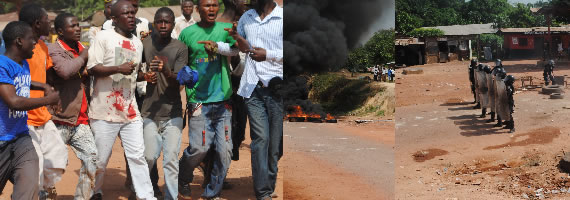
Gbarnga City, Bong County was a scene of chaos on Wednesday, December 12, 2012 when officers of the Liberia National Police (LNP) and some “pen-pen” riders( motorcyclists) clashed.

Bong County, which was created in 1964, is situated in the north-central portion of Liberia. It is one of the 15 counties that comprise the first-level of administrative division in the Liberia, with twelve districts. Gbarnga serves as the Capital City of Bong County, with the land area of the county measuring 8,772 square kilometers (3,387 sq mi). Bong County is named after Mount Bong in the southern portion of the county, it is bordered by Lofa and Gbarpolu counties to the north, Margibi and Montserrado counties to the west, Grand Bassa County to the south, and Nimba County to the east. The northeast part of Bong borders the nation of Guinea.

The clash between the police officers and pen-“pen-pen” riders ensued after a motorcyclist only identified as Kollie was allegedly stabbed by an officer of the Armed Forces of Liberia (AFL). According to eyewitnesses, the AFL officer, who is only identified as Maquincy, allegedly stabbed Kollie after an argument ensued between two of them over balance payment of transportation fare.

The victim, the eyewitnesses narrated, had demanded the AFL officer to pay him L$40(Forty Liberian Dollars) as transportation fare for the service rendered. But the AFL officer, the eyewitnesses further narrated, gave him L$30 on grounds that the fare should be L$30 and not L$40 as claimed by the victim.

While the argument was intensifying, a lady said to be a fiancée of the AFL officer, who was travelling along with him(AFL officer), backed her ‘boyfriend’. At this juncture, the AFL officer ‘fiancée’ irritated the victim with invectives. Infuriated by the invectives, the victim forcibly grabbed her bag with the intent of taking his balance money(L$10). It was at this point that AFL officer allegedly stabbed Kollie with a pair of scissors, said the eyewitnesses.

Kollie was immediately rushed to a hospital for treatment. But up to press time, this paper could not establish his health condition. In retaliation of their colleague, the motorcyclists went on the rampage in Gbarnga at which time they encountered the police. The police had moved in to protect lives and properties as a result of the violence instituted by the angry motorcyclists.

The protesters (motorcyclists) said that they were retaliating for their wounded colleague because the alleged doer of the act had escaped with impunity and that was their way of seeking justice. During the chaotic incident, the protesters set road blocks and burned car tyres.

Their action impeded traffic and normal business activities for at least three hours. Several properties were destroyed during the incident . The incident, which turned the entire Gbarnga city upside-down, coincided with the final day of the just ended Vision 2030 National Conference, which was held in the same city.

Although the incident did not interrupt the official closing of the Vision 2030 National Conference, some of the delegates, mainly government officials moved to the scene of the incident and urged the angry “pen-pen” riders to abandon their violent action.

However, the police later brought the situation under control after engaging the “pen-pen” riders. This paper gathered that some of the protesters got wounded during the incident. But it did not get information regarding injury on the part of police.
Meanwhile, Defense Minister Brownie J. Samukai has expressed regrets over the incident. Speaking on a local radio station in Gbarnga, following the incident, he assured that an investigation will be conducted into the matter.

-Heritage